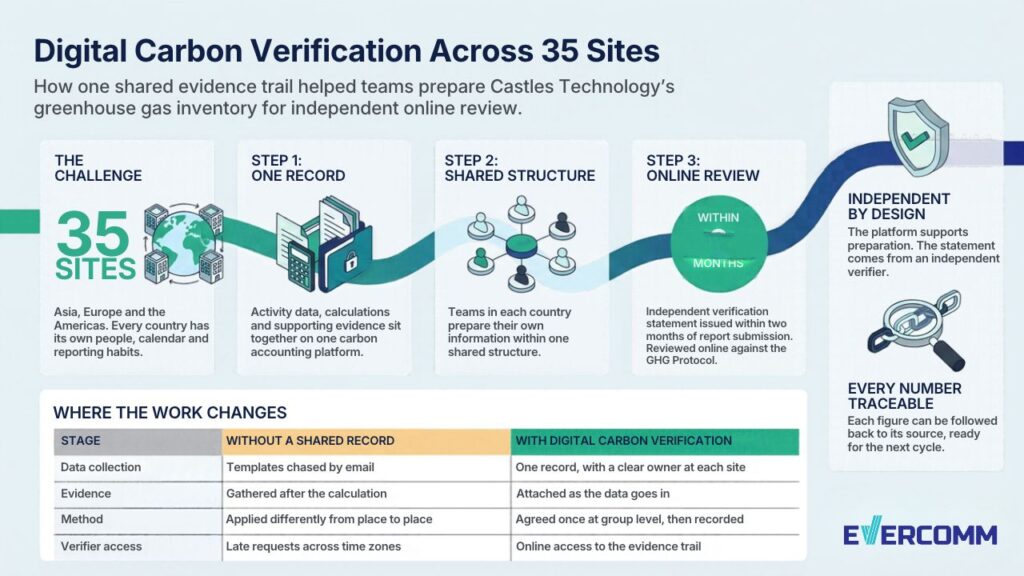
Castles Technology, a TWSE-listed maker of electronic payment terminals, had its 2024 greenhouse gas inventory digitally verified across 35 sites in Asia, Europe and the Americas, with an independent verification statement issued within two months of report submission.
Picture a verifier asking a simple question about one electricity figure at one overseas office. Which invoice sits behind it? Which emission factor was applied, and which version? Who approved the entry? In a single-site inventory, somebody walks down the corridor and finds out. In a multi-country inventory, that one question can cross time zones, languages and shared drives before anyone has an answer. This is the problem digital carbon verification is built to solve, and it has less to do with arithmetic than most finance teams expect.
The Castles Technology project shows the method at work. Evercomm’s carbon accounting platform consolidated activity data, emissions calculations and supporting evidence in one place, so teams in several countries could prepare for online verification against the
GHG Protocol. This article walks through how that kind of project is organised and what other listed, multi-site companies can take from it. It deliberately leaves out the company’s emissions data. The lessons sit in the method, and the method can be shared without it.
Why Digital Carbon Verification Matters to Listed Companies
Emissions data increasingly sits alongside the numbers investors already rely on, and that changes who cares about it. Once a figure appears in a public report, finance and audit committees want to know where it came from, and “the sustainability team compiled it” is no longer a complete answer. Digital carbon verification gives them a better one, because each number can be followed back to its source.
For a CFO, the practical reading is steady: group-level data that can stand up to questioning remains the direction of travel, wherever a company happens to report.
Where Multi-Country Inventories Get Stuck
Companies seldom struggle with verification because they lack commitment. In our experience, the difficulty is usually organisational, and it tends to surface in the same three places.
Coordination. Every country has its own people, working calendar and reporting habits. Facilities data might sit with an office manager in one location and an outsourced landlord in another. A central team sending templates by email spends most of its time chasing and very little of it checking.
Evidence. A number in a spreadsheet tells a verifier nothing about its origin. Utility bills, fuel records and refrigerant logs arrive in different formats and languages, and they often live far from the figure they support. When evidence is gathered after the calculation, each gap becomes a late request, and each late request lands on someone with another job to do. Digital carbon verification reverses that order by attaching evidence as the data goes in.
Method. Emission factors differ by country and change over time. A multinational inventory has to be clear about which source applies where, and it has to apply that choice consistently. The
GHG Protocol Corporate Standard puts the principle plainly: “Use consistent methodologies to allow for meaningful comparisons of emissions over time.”
For hardware and electronics companies in general, supply chains add another layer, because so much of the activity behind a finished product happens outside the company’s own walls. Without a shared record, these three issues compound. With one, they become manageable tasks with clear owners, which is the practical promise of digital carbon verification.
How the Digital Carbon Verification Project Worked
The GHG Protocol defines verification as “an objective assessment of the accuracy and completeness of reported GHG information.” The job of the preparer is to make that assessment possible. In this project, Evercomm’s carbon accounting platform supported the preparation, while the verification statement itself came from an independent verifier. That separation matters, since the credibility of the result depends on it.
The work followed three connected steps.
One record of data, calculations and evidence. Activity data from participating sites was consolidated on the platform, alongside the emissions calculations and the documents supporting them. Everyone worked from the same record, so a question about a figure could start from the figure itself.
Preparation by teams in each country.Teams across multiple countries prepared their own information for review, within a shared structure. Local people stayed close to the data they understood best, while the group gained a consistent view.
Online review against the GHG Protocol. Because the record was digital, verification could take place online. Digital carbon verification does not lower the bar for a verifier. It changes how the verifier reaches the evidence, and it makes cross-border review a matter of access rather than travel. The independent verification statement was issued within two months of report submission.
What Sits Inside a Verifiable Inventory
The outline below draws on the programme’s most recent cycle, which focused on material subsidiaries. It is a separate inventory from the 2024 exercise described above. We share its structure as a useful reference for any team planning digital carbon verification, and we have left its results out.
Coverage. The inventory covers greenhouse gases across Scope 1, 2 and 3, quantified by emissions category.
Emission factors. Sources are chosen by category and geography. Recording that choice for each line makes digital carbon verification simpler, because the reasoning is there to review.
Report and working files. A GHG Protocol report sets out the boundaries, base year, methods and data quality. An inventory workbook holds the line-level detail, and a dashboard summarises the results. All of them descend from the same records, so the summary and the detail stay in step.
Scope decisions deserve particular care as programmes mature. The Corporate Standard asks companies to document boundary changes transparently and to set a policy for recalculating the base year when significant changes occur. Whatever scope a company chooses, the reasoning should be written down well before a verifier or an investor asks about it.