
Login


23/03/2026
General
ESG is no longer a marketing exercise; it is a matter of ESG governance and risk management.
If you have ever looked at the landscape of sustainability reporting and felt overwhelmed, you are not alone.
As Pooja Premjyothi Sanjayan recently noted in a thought-provoking LinkedIn post, the “alphabet soup” of ESG frameworks — from GRI to ISSB to CSRD — can feel impenetrable.
However, as we move through 2026, the conversation is shifting. We are moving away from simply memorizing acronyms and toward a fundamental operational reality:
For organizations today, untangling the complexity starts with understanding why these frameworks exist. They are designed to measure and manage sustainability performance in a structured, transparent way — going beyond financial returns to address long-term risks.
Here is what the latest research says about the state of ESG in 2026, and how businesses can navigate it..
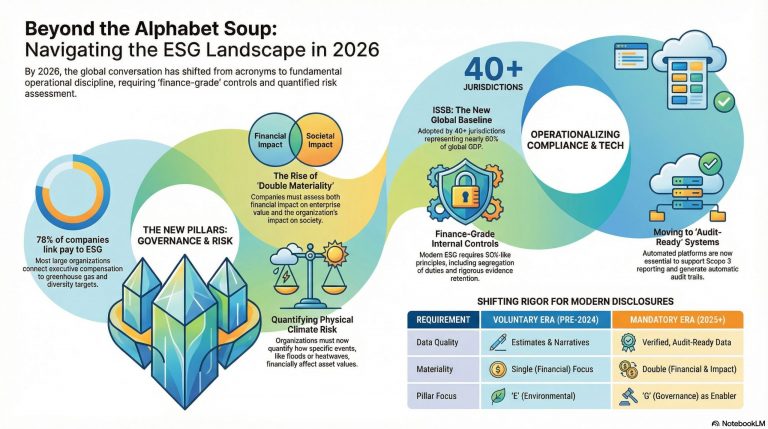
1. The “G” Is the Enabler of “E” and “S”
For years, the Environmental pillar of ESG took center stage. In 2026, Governance has emerged as the linchpin that makes sustainability credible.
Governance is now the enabler that ensures environmental and social goals are achieved responsibly.
Corporate governance has moved beyond compliance checklists to become a benchmark for resilience. Boards are shifting from passive oversight to active, data-driven governance.
Boards are increasingly being held accountable for sustainability performance.
The most common metrics relate to:
Modern ESG programs now require the same rigor as financial reporting.
The days of vague, narrative-driven climate risk statements are over.
In 2026, regulations such as California’s SB 261 and the IFRS S2 standard require companies to treat climate risk as a financial risk, reinforcing the role of ESG governance and risk management at the board level.
The concept of Double Materiality is reshaping reporting, particularly for companies with EU exposure.
Organizations must assess:
It is no longer sufficient to state exposure to climate risks. Companies must quantify how specific risks — such as floods or heatwaves — affect asset values and operational continuity.
Risk management now extends deep into the value chain.
With Scope 3 emissions reporting becoming mandatory in jurisdictions such as California (by 2027) and the EU, companies must manage sustainability data across thousands of suppliers.
While the “alphabet soup” persists, 2026 has brought meaningful consolidation and clarity to the global reporting landscape.
The ISSB standards (IFRS S1 and S2) are emerging as the global baseline.
The EU’s CSRD remains the most comprehensive mandate globally.
Recent “Omnibus” simplification measures:
Despite delays at the federal level, state-level regulations — particularly California’s SB 253 and SB 261 — have effectively created nationwide disclosure expectations for large US companies.
As ESG disclosures shift from voluntary to mandatory, operational expectations have changed dramatically.
Voluntary reports could rely on estimates. Mandatory disclosures require audit trails, controls, and assurance — turning ESG governance and risk management into a systems and data challenge, not just a reporting one. (Keyword use #3)
Manual spreadsheets cannot support double materiality analysis or large-scale Scope 3 data. Automated platforms are now essential.
Effective systems must:
Navigating ESG in 2026 requires looking beyond acronyms and focusing on fundamentals: governance discipline and risk rigor.
Organizations that treat sustainability data with the same standards as financial data can transform compliance into a strategic advantage — strengthening resilience, meeting investor expectations, and supporting long-term value creation.
At Evercomm, we help businesses bridge the gap between complex frameworks and operational reality. Our NXMap and NXOps solutions deliver precision-driven, audit-ready data to help organizations navigate the 2026 regulatory landscape with confidence.


Evercomm is a multi-award winning engineering and technology company helping industries build resilience, unlock growth opportunities and navigate the evolving regulations landscape across carbon, energy, waste, and beyond.
Since 2013, we have been helping businesses optimise resource efficiency, reduce carbon emissions, manage climate risk scenarios, and meet international compliance standards ensuring long-term operational and financial sustainability.
Our advanced planning and simulation tools provide precision-driven carbon, energy and waste reduction strategies tailored to your unique operations. Grounded in internationally recognised ISO Standards, Evercomm ensures data integrity, credibility, and verifiability in emissions reduction tracking and reporting. By integrating globally recognised compliance frameworks, including GRI, SBTi, ISSB, and ESRS, we enable organisations to meet stringent regulatory requirements while reinforcing their business resilience.
As a trusted partner, Evercomm helps businesses turn compliance obligations into strategic advantages ensuring they stay ahead in a rapidly shifting economic and regulatory environment.