

Login

Asia's Industrial Manufacturers Are the Glaring Blind Spot in the Global Just Transition

Date

11/05/2026

Category

General

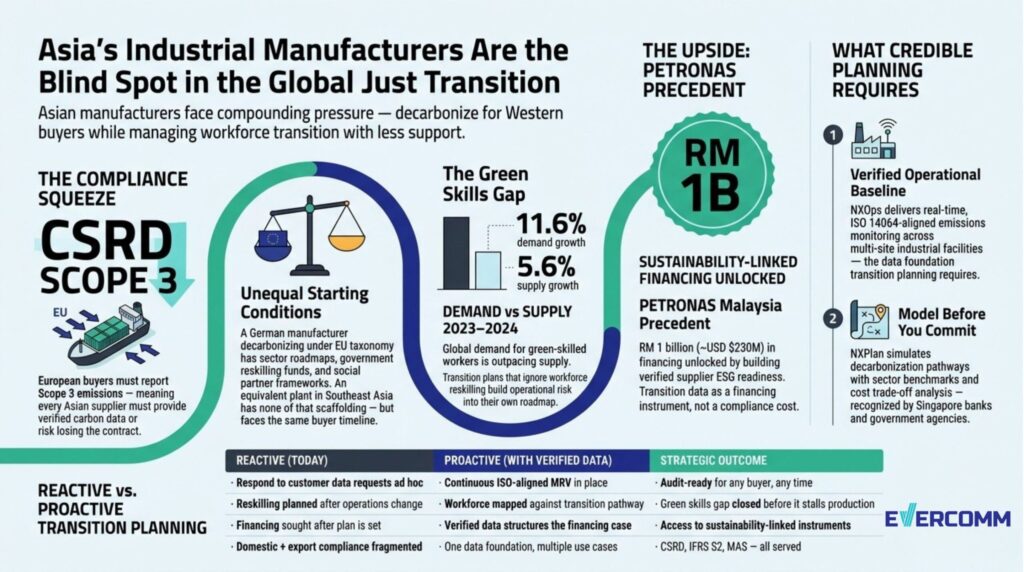
European buyers are not waiting. Under CSRD, large companies operating in or selling to the EU must report Scope 3 emissions — which means every Tier 1 and Tier 2 supplier in their chain must provide verified emissions data. For an export-oriented manufacturer in Malaysia, Thailand, or Taiwan — operating at the front line of just transition Asia — this is not a distant regulatory concern. It is an immediate commercial pressure: verify your carbon footprint or lose the contract.
 
That pressure is arriving ahead of the frameworks designed to help manage it. Asian manufacturers are being pulled into a global just transition architecture that was largely built for Western industrial contexts — with European labour protections, established regulatory bodies, and decades of environmental compliance infrastructure. Most of Asia’s manufacturing heartland has none of that scaffolding in place. The result is a compliance squeeze that is asymmetric, accelerating, and still largely unacknowledged in the just transition Asia discourse.


Asymmetric Pressure, Fragmented Support

 
The just transition Asia challenge has two dimensions that matter operationally. The first is inside-out: the impact a company’s own decarbonization decisions have on its workers, communities, and supply chain. The second is outside-in: how climate disruption affects the people and systems a company depends on. Most transition planning frameworks address both. What they rarely account for is the difference in starting conditions between an industrial company in Germany and one in Penang.
 
A German manufacturer decarbonizing under EU taxonomy obligations can draw on sector-specific roadmaps, government-backed reskilling programmes, and social partner frameworks that have been negotiated at the national level. An equivalent manufacturer in Southeast Asia faces CSRD-driven Scope 3 demands from its European customers, while simultaneously navigating domestic policy environments that are still developing. There is no regional equivalent of the EU’s Just Transition Fund. Workforce transition support is patchy. And the timeline imposed by Western buyer requirements is not calibrated to those local realities.
 
This is not an argument against decarbonization. It is a precise description of the operating conditions Asian manufacturers face — conditions that demand a differentiated strategic response, not a copy-paste of what works in Frankfurt or Amsterdam.

The Green Skills Gap Is an Operational Risk

 
Buried in the just transition Asia literature is a workforce data point that deserves far more attention from Manufacturing Operations Directors. Global demand for green-skilled workers rose 11.6% in 2023–2024. Supply grew by only 5.6%. That gap is widening, not closing.
 
For Asian manufacturers, this is not an abstract talent market signal. It is an operational constraint. Decarbonization at the facility level — retrofitting equipment, shifting to lower-emission processes, installing monitoring systems — requires people who understand both industrial operations and emissions accounting. Those people are scarce. They are becoming more scarce. And because most just transition frameworks focus on protecting existing workers from job loss, rather than building the new capabilities industrial operations actually need, manufacturers are left to solve this problem largely on their own.
 
The companies that are navigating this well are treating green skills as a capital allocation decision, not a training budget line. They are mapping the specific technical competencies their transition pathways require, identifying which roles need reskilling versus which require new hires, and sequencing workforce development in parallel with operational changes. That kind of planning requires knowing where you are going — which means having credible, facility-level transition data to work from.


The PETRONAS Precedent: Transition Planning as Bankable Value

 
There is a common assumption in the region that ESG compliance is a cost imposed by Western buyers, with no domestic upside. The PETRONAS Malaysia example challenges that directly.
 
By building supplier ESG readiness across its value chain, PETRONAS unlocked RM 1 billion — approximately USD $230 million — in sustainability-linked financing. That is not a compliance exercise. That is a demonstration that verified, structured transition planning generates bankable value. The financing became available precisely because the data was credible enough for lenders to price against.
 
The financial materiality runs in both directions. Research consistently shows that companies with strong social performance deliver 3–7% higher five-year total returns. And the cost of getting it wrong is not theoretical: community conflict added USD $750 million to the cost of a single energy infrastructure project. The licence to operate is an economic asset. Managing the social dimensions of the transition — workforce, community, supply chain — is a financial decision, not a reputational one.
 
For Asian manufacturers considering sustainability-linked financing, green bonds, or government-backed transition funds that are beginning to emerge across ASEAN, the question is the same one their Western counterparts faced five years ago: do you have the data to make the case?
 
Just Transition Asia

What Credible Transition Planning Requires Operationally

 
Most Asian manufacturers entering the transition planning cycle — whether driven by CSRD supplier requirements, IFRS S2 disclosure obligations, or domestic frameworks like Singapore’s MAS guidelines — discover the same problem early in their just transition Asia journey: they cannot set credible ambition without first understanding where they actually stand. Without facility-level emissions data, transition scenario modelling is guesswork dressed up as strategy.

This is where Evercomm’s operational tools address a specific gap. NXOps provides real-time emissions monitoring across multi-site industrial facilities, building the ISO 14064-aligned audit trails that verified reporting requires — and that, critically, are recognised by Singapore banks and government agencies. NXMap surfaces the data needed to understand baseline performance across a complex operation. NXPlan then uses that operational foundation to model transition scenarios against sector-specific benchmarks, with cost and investment trade-off analysis built in.

The transition planning cycle described in frameworks like IFRS S2 follows a clear sequence: re-assess, set ambition, plan actions, implement. For manufacturers who have been responding reactively to customer data requests — producing inconsistent, unverified numbers under deadline pressure — the re-assess stage is not a formality. It is the work that makes every subsequent stage credible. The operational intelligence layer comes before the ambition-setting, not after.

Evercomm operates across Singapore, Malaysia, Thailand, and Taiwan — the same geographies where just transition Asia pressure is most acute. That regional grounding matters. Industrial facilities in these markets have specific infrastructure characteristics, regulatory environments, and operational rhythms that generic global platforms are not built to handle.
 

Planning Ahead of the Pressure

 
The manufacturers who will navigate the next five years with the most strategic room to manoeuvre are the ones building their transition data infrastructure now — not in response to the next customer audit, but in anticipation of it. CSRD’s Scope 3 requirements are tightening. IFRS S2 adoption is expanding across the region. Sustainability-linked financing conditions are becoming more data-intensive. The window to move from reactive to planned is narrowing.


The just transition Asia framework, for all its blind spots around regional industrial realities, contains a useful structural insight: the social and human dimensions of decarbonization are not separate from the operational ones. Workforce reskilling, supply chain readiness, community impact — these are all downstream of the same question: do you know precisely where your operation stands, and where it needs to go?


Asian manufacturers have the operational complexity, the export market exposure, and — increasingly — the access to financing instruments that make credible transition planning a genuine strategic advantage. The scaffolding is thinner than in Europe. That makes the quality of the operational data more important, not less.

If you are a Manufacturing Operations Director or CSO at an Asian industrial company evaluating your transition planning approach, Evercomm works with manufacturers across Singapore, Malaysia, Thailand, and Taiwan to build the operational data foundation that credible transition planning requires.

Reach out to discuss what that looks like for your facilities.
Browse More Articles

Just Transition Asia
Just Transition Asia: The Manufacturing Blind Spot
Asian manufacturers face a double pressure — decarbonize for Western buyers under CSRD while managing...
Just Transition
Just Transition Planning Needs High-Integrity Emissions Data
Companies building just transition strategies on unverified carbon data face real financial and regulatory...
ISO 14001:2026 change
ISO 14001:2026 Update: What Changed and What It Means
ISO 14001:2026 published April 2026. Understand the key changes from 2015, what's now required, and how...

Chatbot

Hey there 👋
How can I help you today?