

Login

MAS Transition Planning:
What Industrial Firms Must Know

Date

16/04/2026

Category

General

Your Bank Is Now Required to Ask About Your Carbon Data

 
What MAS’s new transition planning guidelines mean for industrial companies and why your answer needs to be credible.
 
Your CFO might be reading this from a business update. Your operations director might have seen the headline pass through his LinkedIn feed. Either way, something shifted on 5 March 2026 that every industrial company doing business with a Singapore-regulated bank, insurer, or fund manager needs to understand.

The Monetary Authority of Singapore published its Guidelines on Environmental Risk Management — Transition Planning. These are not voluntary. They apply to every bank, insurer, and asset manager regulated by MAS, effective September 2027. And they change what your financial institution is now required to do with your carbon data.

The New Expectation: Your Bank Must Understand Your Climate Risk


MAS has made it unambiguous. Banks must implement “structured customer engagement” to collect sufficient climate-related data from the companies they lend to. Insurers must do the same for underwriting. Asset managers must factor it into how they manage and vote on investee portfolios.

The guidelines describe transition planning as “the internal risk management process and strategic planning undertaken by an entity to prepare for climate-related risks.” In plain terms: every financial institution you work with is now expected to have a process for assessing how climate change affects their exposure to your business — and you are part of that exposure.

Boards and senior management at financial institutions are required to embed climate considerations into their risk appetite and business strategy. That means the question of your company’s carbon performance is no longer just a sustainability conversation. It is a credit conversation. An underwriting conversation. An investment strategy conversation.
 

The Mistake Most Companies Are Already Making


Here is the assumption that will cost companies: that this only applies to financial institutions, and industrial companies can wait and see.

They cannot.

The guidelines are explicit that engagement should be “risk-proportionate” — which means the heavier your carbon footprint, the more scrutiny you will attract. MAS has also been clear that financial institutions should not “indiscriminately withdraw credit or coverage” from companies that face climate risk. Instead, they are expected to engage and support transition.

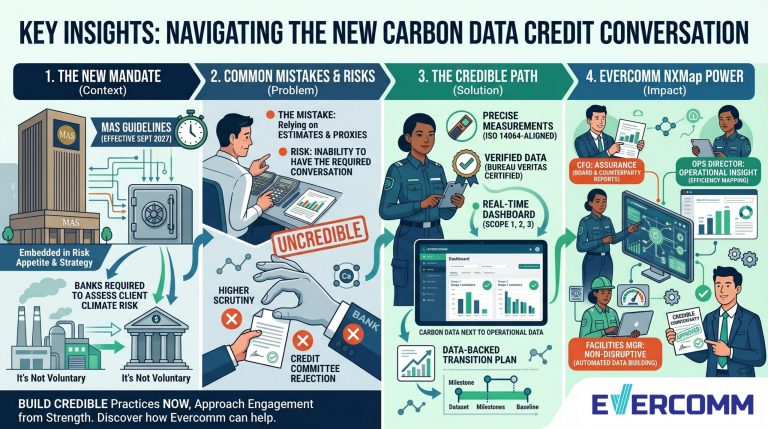
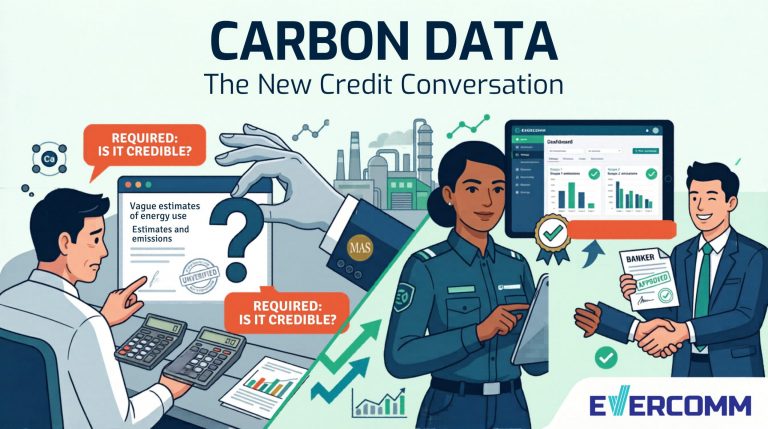
That sounds reassuring. But the word that matters is *credible*. Financial institutions are expected to distinguish between companies with credible transition plans and those with none. A company that cannot demonstrate verified, measurable emissions data — across its facilities and operations — is not in a position to have that conversation with confidence.

The risk is not immediate exclusion. The risk is being unable to participate in a conversation your bank is now required to have — and coming to that table with nothing but estimates.

What the Smarter Companies Are Doing Now

 
The industrial companies that will navigate this well are the ones building their carbon data infrastructure before they are asked for it.
That means:
 
  • Knowing their numbers precisely. Not approximate. Not estimated from industry averages. ISO 14064-aligned measurements, verified and audit-ready. The companies that can hand a financial institution a Bureau Veritas-verified carbon performance report are not just compliant — they are bankable.
  • Treating climate data as financial data. – Scope 1, Scope 2, and where relevant, Scope 3 emissions data belongs on the same operational dashboard as energy costs and production output. Leading operations directors are already tracking carbon performance in real time, not retrospectively at year-end.
  • Demonstrating a transition plan, not just a commitment. MAS’s guidelines are specifically designed to surface whether companies are planning toward a low-carbon future or simply declaring intentions. A transition plan has milestones. It has baselines. It has data behind it. Qualitative pledges do not survive a credit committee’s scrutiny.
This is not about being a sustainability leader. It is about being a credible counterparty.
 

How Evercomm Helps You Prepare for This Moment

This is precisely the kind of pressure Evercomm was built to address.
 
Our NXMap platform delivers ISO 14064-aligned, real-time carbon performance monitoring across your industrial operations — verified by Bureau Veritas, and recognised by Singapore government agencies and financial institutions. When your bank or insurer begins structured engagement on your climate risk, you are not starting the conversation from zero. You are arriving with verified data, a clear emissions baseline, and an actionable reduction pathway.
 
For CFOs, that means assurance — reports your board and financial counterparties can rely on. For operations directors, it means operational insight that maps sustainability performance directly to production efficiency. For facilities managers, it means a non-disruptive system that runs continuously in the background, building the data record your organisation will need.
 
The September 2027 implementation date feels distant. Eighteen months moves fast when your financial institutions are building new internal processes and starting to ask new questions.
 

The Bottom Line

MAS has set a clear direction: financial institutions must understand the climate risk in their portfolios — and that requires understanding the climate risk in the companies they serve. Industrial companies that build credible, verified carbon data practices now will approach that engagement from a position of strength.
 
Those that don’t will find that the conversation becomes a negotiation they weren’t prepared for.
 
Ready to ensure your carbon data stands up to institutional scrutiny? Let’s talk about your transition readiness. Discover how Evercomm can help. 

Browse More Articles

MAS transition planning
MAS Transition Planning: What Industrial Firms Must Know
MAS's 2026 transition planning guidelines require banks to assess your carbon risk. What industrial companies...
ESG governance and risk management
Beyond the Alphabet Soup: Why Governance and Risk Management Are the New ESG Standard in 2026
ESG success is defined by governance and risk management. Learn how companies are moving beyond ESG frameworks...
Carbon Tax 2026
Carbon Tax Is Rising Again — If You’re Not Measuring Emissions, You’re Exposed
Singapore’s carbon tax jumps to $45/tonne in 2026—carbon is now a real cost for business. Companies that...

Chatbot

Hey there 👋
How can I help you today?