
Login


16/04/2026
General
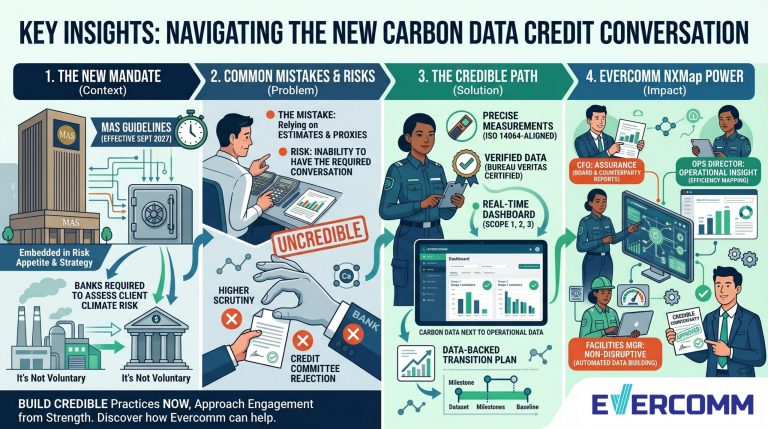
The Monetary Authority of Singapore published its Guidelines on Environmental Risk Management — Transition Planning. These are not voluntary. They apply to every bank, insurer, and asset manager regulated by MAS, effective September 2027. And they change what your financial institution is now required to do with your carbon data.
MAS has made it unambiguous. Banks must implement “structured customer engagement” to collect sufficient climate-related data from the companies they lend to. Insurers must do the same for underwriting. Asset managers must factor it into how they manage and vote on investee portfolios.
The guidelines describe transition planning as “the internal risk management process and strategic planning undertaken by an entity to prepare for climate-related risks.” In plain terms: every financial institution you work with is now expected to have a process for assessing how climate change affects their exposure to your business — and you are part of that exposure.
Here is the assumption that will cost companies: that this only applies to financial institutions, and industrial companies can wait and see.
They cannot.
The guidelines are explicit that engagement should be “risk-proportionate” — which means the heavier your carbon footprint, the more scrutiny you will attract. MAS has also been clear that financial institutions should not “indiscriminately withdraw credit or coverage” from companies that face climate risk. Instead, they are expected to engage and support transition.
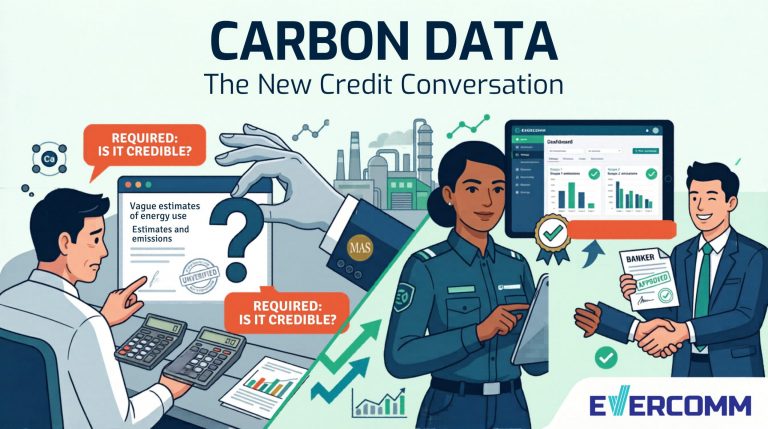
That sounds reassuring. But the word that matters is *credible*. Financial institutions are expected to distinguish between companies with credible transition plans and those with none. A company that cannot demonstrate verified, measurable emissions data — across its facilities and operations — is not in a position to have that conversation with confidence.
The risk is not immediate exclusion. The risk is being unable to participate in a conversation your bank is now required to have — and coming to that table with nothing but estimates.



Evercomm is a multi-award winning engineering and technology company helping industries build resilience, unlock growth opportunities and navigate the evolving regulations landscape across carbon, energy, waste, and beyond.
Since 2013, we have been helping businesses optimise resource efficiency, reduce carbon emissions, manage climate risk scenarios, and meet international compliance standards ensuring long-term operational and financial sustainability.
Our advanced planning and simulation tools provide precision-driven carbon, energy and waste reduction strategies tailored to your unique operations. Grounded in internationally recognised ISO Standards, Evercomm ensures data integrity, credibility, and verifiability in emissions reduction tracking and reporting. By integrating globally recognised compliance frameworks, including GRI, SBTi, ISSB, and ESRS, we enable organisations to meet stringent regulatory requirements while reinforcing their business resilience.
As a trusted partner, Evercomm helps businesses turn compliance obligations into strategic advantages ensuring they stay ahead in a rapidly shifting economic and regulatory environment.