Three Doors That Open
Lower borrowing costs
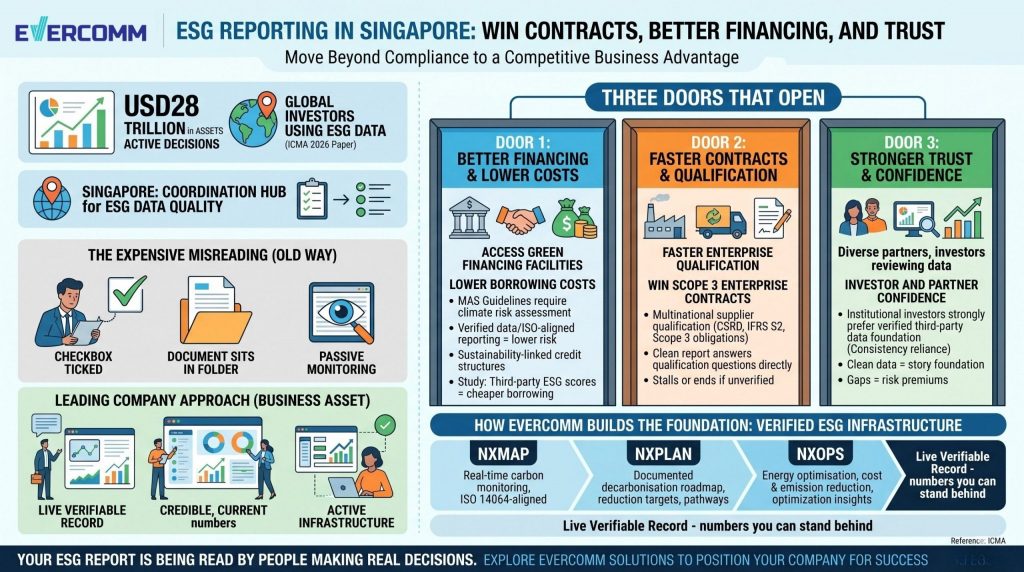
Singapore banks and financial institutions are now required, under MAS guidelines, to assess the climate risk profile of the companies they lend to. Companies with verified emissions data, a documented reduction pathway, and ISO-aligned reporting are demonstrably lower risk. They are positioned to negotiate better loan terms, access green financing facilities, and satisfy the growing number of sustainability-linked credit structures in the Singapore market. A study published in October 2025 found that municipal bonds with third-party ESG scores traded at higher prices — which translates directly to cheaper borrowing costs for the issuer. A company that cannot produce verified ESG data is, by contrast, a question mark in a credit committee — and question marks cost money.
Faster enterprise qualification.
Large corporates — particularly multinationals with Scope 3 reporting obligations under CSRD, IFRS S2, and equivalent frameworks — must now account for the emissions of their suppliers. When a procurement team runs a supplier qualification process, your ESG report is the document that answers their questions before they have to ask. A verified, ISO-aligned report accelerates that conversation. An unverified or incomplete one stalls it, or ends it.
Investor and partner confidence.
The ICMA survey found that institutional investors strongly prefer using verified third-party data as the foundation of their own internal assessments — because it gives them consistency they can rely on. Almost all respondents (13 of 14) confirmed they source the data for their internally-produced ESG ratings and scores from third-party providers. When your ESG data is clean, it becomes the foundation of a story that institutions can build on. When it is not, you become a gap in their model. Gaps generate risk premiums. Clarity generates confidence.
What the Leading Companies Are Doing Differently
The companies navigating this well share one common approach. They treat ESG reporting not as an annual exercise but as a continuous operational discipline. They maintain a verified emissions baseline, measured in real time, aligned to ISO 14064, third-party audited. They track progress against targets. And when they sit down with a bank, an investor, or an enterprise client, they arrive with data that speaks for itself.
They are not necessarily the companies with the lowest carbon footprint. They are the companies with the most credible, current, and verifiable account of where they stand and where they are going.
That is what a business story built on ESG data looks like. Not a polished report published once a year. A live, verifiable record that says: we know our numbers, our numbers are reliable, and we are moving in the right direction.
In a market where USD28 trillion in capital is being allocated with ESG data as a key input, that record is a competitive advantage.
How Evercomm Builds That Foundation
Building a credible ESG record requires the right infrastructure beneath it.
NXMap delivers real-time, ISO 14064-aligned carbon performance monitoring across your industrial operations — verified by Bureau Veritas and recognised by Singapore government agencies and financial institutions. It produces the verified baseline that gives your ESG narrative its foundation: numbers you can stand behind in a board presentation, a credit committee, or a procurement review.
NXPlan translates that baseline into a documented decarbonisation roadmap — reduction targets, efficiency pathways, milestone tracking. The elements that turn a data record into a story with direction.
NXOps keeps the operational picture current, identifying energy optimisation opportunities that reduce costs and emissions at the same time — because the best sustainability story is also a good business story.
For CFOs, this means your ESG data holds up wherever it is scrutinised. For operations directors, it connects sustainability performance directly to production efficiency. For facilities managers, it delivers continuous measurement without disrupting daily operations.
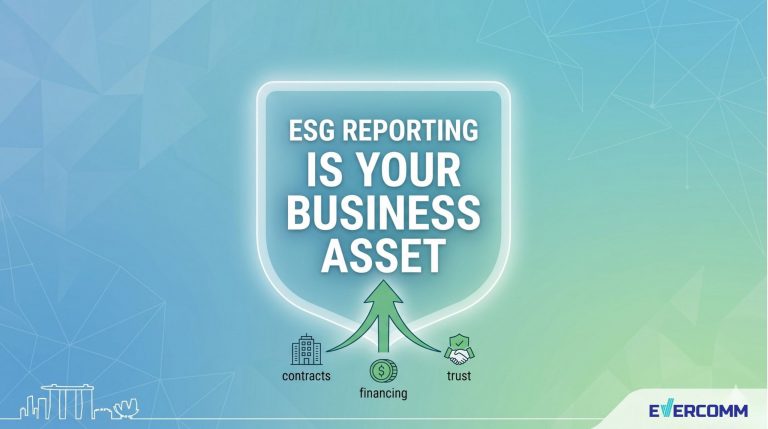
The ESG report you produce next quarter can be a compliance document, or it can be a business asset. The difference is not in how you present it. It is in the quality and credibility of the data underneath.
The Bottom Line
ICMA’s 2026 paper makes clear that the infrastructure of global capital is already built around ESG data. Singapore’s regulatory framework, one of the first in the world to formalise a Code of Conduct for ESG data providers has set the standard for how that data should be produced and verified. Globally, 42 ESG data providers have now signed up to the ICMA Code of Conduct, with 23 having submitted formal Statements of Application. The standard Singapore helped establish is the standard the world is moving towards. The companies that build their ESG reporting to that standard are not just complying. They are positioning.
The report you file today is being read by people making real decisions about your business — financing, contracts, partnerships. Make sure it tells the right story.