The Smarter Approach: From Data to Dialogue
Leading institutions have already begun bridging this gap and the results are measurable.
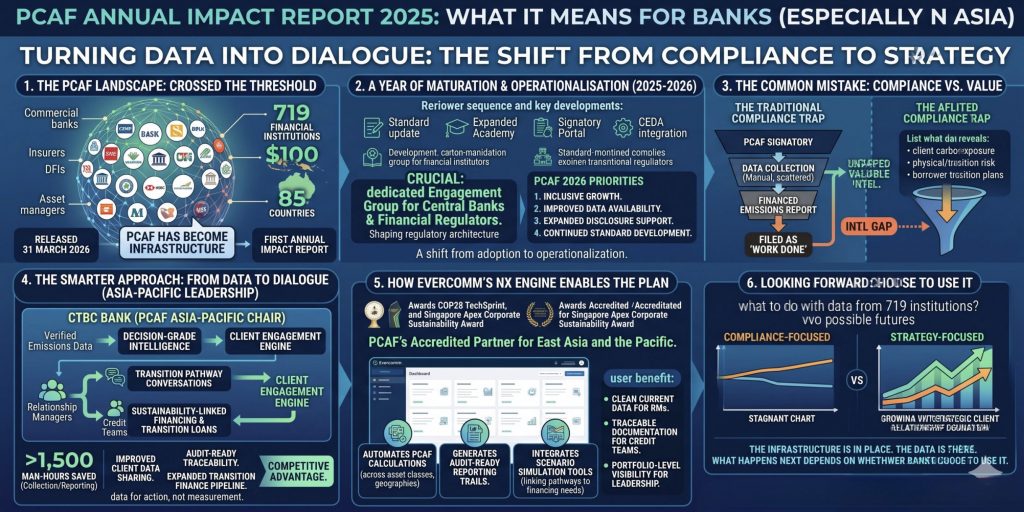
CTBC Bank, as the PCAF Asia-Pacific Chair, offers one of the clearest examples. Rather than treating financed emissions as a reporting output, CTBC has rebuilt its PCAF framework as a
client engagement engine. Verified emissions data flows into bankers’ hands as decision-grade intelligence.
Relationship managers use it to open conversations about transition pathways. Credit teams use it to structure sustainability-linked financing and transition loans.
The outcomes from this approach are concrete: over 1,500 man-hours saved in data collection and reporting cycles, improved client participation in data sharing, audit-ready traceability across jurisdictions, and an expanded transition finance pipeline, converting what was once compliance data into actionable credit opportunities.
The underlying logic is straightforward. A client who shares their emissions data and receives a credible, costed decarbonisation pathway in return is a client who stays. A bank that can structure that pathway into a bankable financing product has moved from service provider to strategic partner.
PCAF’s 2026 priorities — particularly the focus on improved data availability and expanded disclosure support — are designed to make this kind of value creation easier and more replicable across the community. The direction of travel is clear: the Standard is being built not just to measure emissions, but to enable action on them.
How Evercomm Enables This
Building the digital infrastructure for PCAF compliance is where most institutions find the real friction. Emissions data is scattered across asset classes, geographies, and internal systems. Calculations need to be methodology-consistent and auditable. Reports need to align with IFRS S2 and CSRD. All of it needs to be ready when the regulator or credit committee asks.
Evercomm’s NX Engine powers financed emissions and transition finance frameworks for financial institutions operating in this space, already recognised at the UNFCCC COP28 TechSprint Award and the Singapore Apex Corporate Sustainability Award, and formalised as
PCAF’s Accredited Partner for East Asia and the Pacific, bridging global standards with regional implementation across the region. The platform automates PCAF-aligned calculations across asset classes, generates audit-ready reporting trails, and integrates scenario simulation tools that link decarbonisation pathways directly to financing needs.
For a bank trying to move from compliance reporting to client engagement, the technology layer matters. Relationship managers need clean, current data. Credit teams need traceable documentation. Leadership needs portfolio-level visibility. Evercomm’s platform is built to serve all three, reducing manual workload while raising data confidence.
The goal is not to make PCAF easier to file. It is to make the data inside PCAF worth using.
Looking Forward
The publication of PCAF’s first Annual Impact Report marks a turning point — not because the numbers are large, though they are, but because the organisation has chosen to make its progress legible and accountable.
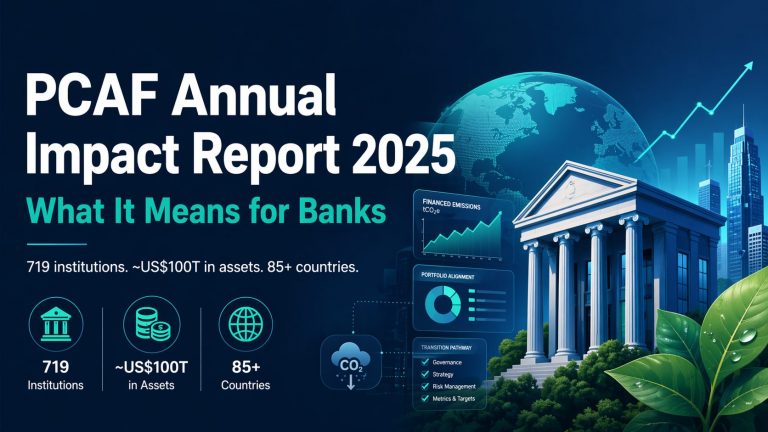
Seven hundred and nineteen institutions have signed on. The question now is what they do with the data they have committed to collect.
The most competitive financial institutions in the years ahead will be the ones who answered that question early — who treated financed emissions not as a column in a report, but as the foundation of a new kind of client relationship.
The infrastructure is in place. The Standard is maturing. The data is there. What happens next depends on whether banks choose to use it.
Curious about how Evercomm supports financial institutions with PCAF-aligned financed emissions reporting and transition finance?
Let’s talk about what that looks like for your portfolio.