What Changed: The 2015 Standard vs 2026
1. The Environment Itself Is Now Part of the Picture
Before: ISO 14001:2015 asked organisations to consider how their activities impact the environment.
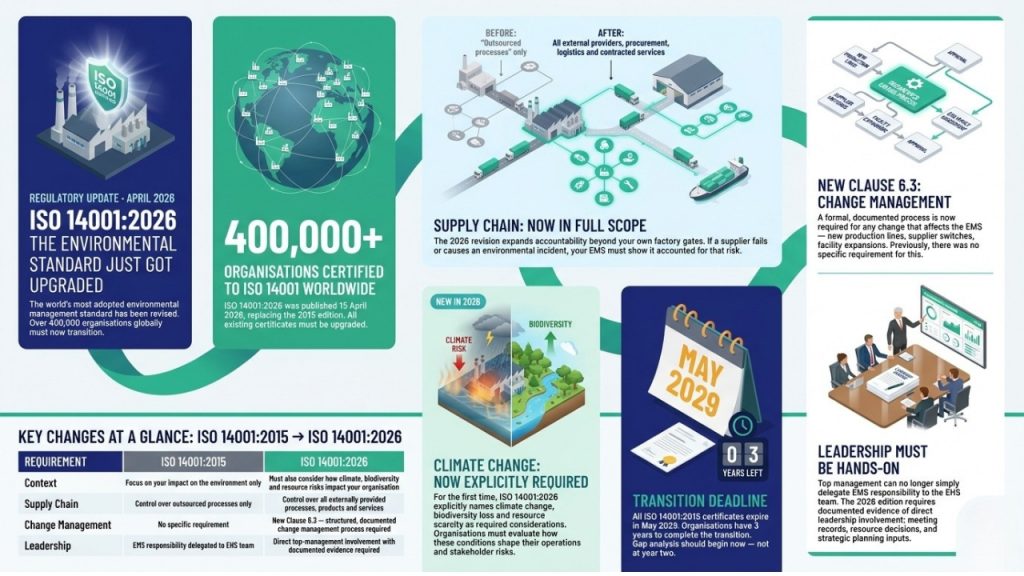
After: ISO 14001:2026 also asks how the environment impacts the organisation, specifically how climate change, biodiversity loss, pollution levels, and resource scarcity shape business risk and stakeholder expectations.
In plain terms: you can no longer treat the environment as a passive backdrop. Extreme weather, water stress, biodiversity decline, these are now factors you are required to evaluate when building your environmental management system, not just annual report footnotes.
This reflects where risk conversations in boardrooms and credit committees already are. The standard is simply catching up.
2. Supply Chain Accountability Has Expanded Significantly
Before: Organisations were required to control their outsourced processes.
After: Scope expands to externally provided processes, products and services — covering contractors, procurement, logistics, and distribution partners.
This is the most operationally significant change for industrial organisations. It means your certified EMS must now demonstrate reach beyond your own factory gates. If a waste contractor fails, if a supplier’s logistics causes an environmental incident, or if raw material sourcing creates biodiversity impact, your system is expected to account for those risks.
For manufacturing operations directors, this will require a clear-eyed review of vendor management, procurement controls, and emergency response protocols that extend into the supply chain.
3. Formal Change Management Is Now Required (New Clause 6.3)
Before: There was no dedicated requirement for how organisations manage changes that affect the environmental management system.
After: A new clause requires a structured process to plan, evaluate, and communicate changes, whether that is a new production line, a supplier switch, a facility expansion, or a shift in operations.
This protects against a common failure mode: an organisation changes something significant, and the environmental management system is not updated to reflect it. That gap is what auditors find. The new clause closes it.
4. Leadership Cannot Delegate and Disappear
Before: Top management was required to support environmental management, but in practice much of this accountability was delegated to the EHS or sustainability team.
After: ISO 14001:2026 extends the leadership requirement beyond management roles to all relevant roles and expects evidence of direct involvement from the top: meeting minutes, resource allocation decisions, strategic planning inputs.
For CFOs and operations directors, this means environmental performance is formally positioned as a leadership matter, not a compliance function. That is not a burden — it is alignment with how regulators, lenders, and institutional investors already view it.
5. Climate Change Is Now Explicitly Named
Before: Climate change was implicit within broader environmental considerations.
After: Climate change is explicitly listed as a required consideration in organisational context — alongside pollution levels, biodiversity, and resource availability.
This formalises what many organisations have already been doing voluntarily. For those that have not yet built climate risk into their EMS, this is the call to start.
6. Lifecycle Thinking Gets Sharper Teeth
Before: Organisations were expected to consider lifecycle perspective in managing environmental aspects.
After: The lifecycle requirement is strengthened and applied more explicitly across product design, procurement, upstream extraction impacts, and downstream disposal.
In practice: if you design a product, procure a material, or run a service — you are now expected to think about its full environmental journey, not just the impact that happens on your premises.
7. Internal Audits Must Have Documented Objectives
Before: Internal audits were required; the purpose was implied.
After: Each audit must have explicitly documented objectives in the audit plan.
This is a small but meaningful change. It shifts internal audits from a box-ticking exercise toward a purposeful, risk-based tool — one that is aligned with what the organisation is actually trying to manage and improve.
8. Management Reviews Are Restructured
Before: Management reviews were treated as a single process.
After: Reviews are split into three defined sub-clauses: inputs, process, and results.
This restructuring elevates the management review from an annual formality to an active performance and compliance monitoring mechanism. The question it now has to answer is not “did we comply?” but “are we improving, and how do we know?”
The Bottom Line: What This Means for Your Organisation
| What | Before (2015) | After (2026) |
|---|
| Context | Focus on your impact on the environment | Now also: how climate, biodiversity & resource risks impact you |
| Supply chain | Control “outsourced processes” | Control all externally provided processes, products & services |
| Change management | No specific requirement | New Clause 6.3 — must document and manage EMS-related changes |
| Leadership | Top management supports EMS | Evidence of direct involvement from all relevant leadership required |
| Climate change | Implicit | Explicitly named as a required consideration |
| Lifecycle thinking | Expected in principle | Now applied explicitly across design, procurement, and disposal |
| Internal audits | Required | Each audit must have documented objectives |
| Management review | Single process | Restructured into inputs, process, and results sub-clauses |
The 2026 revision is not a reinvention. Organisations already operating a robust ISO 14001:2015 system will find many of these changes are already reflected in good practice. The standard is catching up to what leading companies have been doing.
For others, this is a structured prompt to close the gaps — before an auditor does it for them.
The Transition Deadline: May 2029
All certificates issued under ISO 14001:2015 must be transitioned to ISO 14001:2026 before May 2029. After that date, 2015-edition certificates will no longer be valid.
Three years feels comfortable. In practice, the organisations that transition smoothly are those that begin the gap analysis now, mapping what they have against what is required and build the transition into their normal audit and review cycles rather than treating it as a separate project.
How Evercomm Helps Organisations Prepare
Environmental management does not end at documentation. The changes in ISO 14001:2026 — particularly around climate integration, supply chain accountability, and lifecycle thinking — require organisations to have real, reliable data about their actual environmental performance.
That is where the gap between a documented system and a credible one tends to show up under audit.
Evercomm’s platforms — NXMap, NXPlan, and NXOps — are built precisely for this: real-time emissions monitoring, AI-driven scenario planning, and energy performance tracking that feeds directly into verified, ISO 14064-aligned reports. The kind of reports that hold up with Bureau Veritas verification, Singapore government recognition, and increasingly, credit committees and procurement teams.
If your team is beginning the ISO 14001:2026 transition, the data foundation matters as much as the documentation.
Discover how Evercomm can support your transition. Reach out to our team to understand where your current environmental data stands — and what it would take to be audit-ready before 2029.