PCAF’s July 2026 policy brief confirms a fragmented, fast-moving regulatory wave across Asia-Pacific — and it puts Scope 3 Category 15 squarely in front of every bank CRO.
Sixteen. That’s how many jurisdictions across Asia-Pacific now have, or are actively building, emissions disclosure requirements for financial institutions. That’s the headline number in PCAF’s APAC Regional Policy Brief, published in July 2026 — and it confirms what sustainability and risk teams at regional banks have quietly suspected for a while: financed emissions APAC reporting is no longer a market-by-market compliance task. It is a regional operating requirement, moving at different speeds in different places, and converging on the same category every time — Scope 3, Category 15.
Why Financed Emissions APAC Reporting Just Got More Complicated
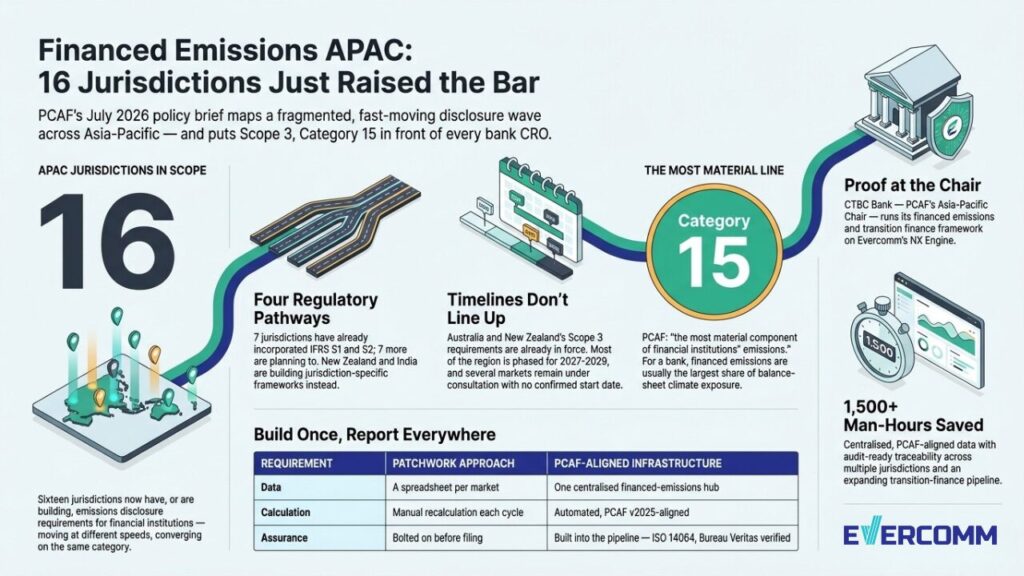
For a long time, tracking financed emissions APAC obligations meant watching a handful of frontrunners: Singapore’s SGX listing rules, Japan’s early ISSB alignment, Australia’s Scope 3 requirement already in force. PCAF’s July 2026 brief shows how much that picture has widened. Sixteen jurisdictions now have, or are building, disclosure requirements for financial institutions, and the brief maps at least four distinct regulatory pathways running at once — most phased by entity type, size, or market capitalisation.
Seven jurisdictions — Australia, Hong Kong SAR, Japan, Malaysia, the Philippines, Singapore, and Sri Lanka — have already incorporated the IFRS Foundation’s ISSB standards, IFRS S1 and S2, into their regulatory frameworks. A further seven — Bangladesh, China, Chinese Taipei, Indonesia, Nepal, South Korea, and Thailand — are planning to. New Zealand has built its own jurisdiction-specific framework rather than adopting ISSB directly, and India’s equivalent — a draft Disclosure Framework on Climate-related Financial Risks — is still under consideration.
Phase-in timelines are just as uneven. Australia and New Zealand’s Scope 3 requirements are already in effect. Most of the rest of the region is phased for 2027 through 2029. A handful of markets remain under consultation, with no confirmed start date yet. In Singapore, Scope 3 disclosure under SGX’s 711A and 711B rules currently applies only to Straits Times Index constituents — a narrower scope than many banks assume when they read “Singapore requires Scope 3” as a blanket statement. In India, the draft framework introduces Scope 3 under phased adoption starting in 2027.
Most of the sixteen frameworks are also phased internally, not just staggered market to market. The brief notes that jurisdictions typically scope requirements by entity type, size, or market capitalisation — meaning a bank’s largest listed clients can already be in scope for Scope 3 disclosure in a market where the bank itself, or a mid-cap borrower, still has years of runway left. That internal phasing is easy to miss when a compliance team reads a country’s requirement as a single on/off switch rather than a schedule with its own tiers.
PCAF is direct about why this lands hardest on Category 15. As the brief states: “As the global standard-setter for Scope 3, Category 15, PCAF addresses the most material component of financial institutions’ emissions.” For a bank, that category usually isn’t one line item among many — it’s the largest share of the balance sheet’s climate exposure, and it’s the number behind every financed emissions APAC disclosure that regulators, rating agencies, and credit committees are now asking to see. The full brief is available through
PCAF’s Carbon Accounting Financials, alongside the underlying
IFRS Sustainability Disclosure Standards.
The Fragmentation Risk: One Deadline Isn’t the Story
Here’s where most financial institutions get financed emissions APAC readiness wrong. They treat it as a single regional compliance deadline — pick a year, build toward it, done. PCAF’s brief tells a different story. Sixteen jurisdictions, four distinct regulatory pathways, phase-in dates spanning 2023 to 2029. That’s not one deadline. It’s sixteen, moving at different speeds, built on different legal foundations.
The risk shows up quickly for any bank operating across more than one APAC market. A regional lender headquartered in a jurisdiction with a 2029 phase-in can build a Scope 3 Category 15 reporting process calibrated entirely to that timeline — only to find a subsidiary, a portfolio company, or a syndication partner sits in a market where the same requirement is already in effect, or moving faster than expected. As the brief itself notes, “New Zealand and India are establishing jurisdiction-specific frameworks, while other markets are incorporating IFRS S1 and S2 into their regulatory frameworks.” Those pathways are not interchangeable. A reporting process built for one does not automatically satisfy the other.
The common mistake isn’t a lack of ambition. It’s architecture. Banks build financed emissions APAC reporting as a set of jurisdiction-specific patches — a spreadsheet for the home market, a consultant’s model for the subsidiary, a manual workaround wherever the next deadline lands. Every patch works fine, right up until the portfolio crosses a border the process wasn’t built for.
What Leading Institutions Are Building Instead
The banks getting ahead of this aren’t betting on a single jurisdiction’s timeline. They’re building financed emissions APAC infrastructure once, aligned to PCAF’s methodology, and treating each local regime — ISSB-adopted, ISSB-planned, jurisdiction-specific, or still under consultation — as a reporting output of that same underlying data, not a separate build.
That works because PCAF’s standards are designed for exactly this. The brief describes PCAF’s methodologies as built to be interoperable with IFRS S1 and S2 and with national frameworks — which means a financed-emissions data structure aligned to PCAF’s methodology travels across most of the sixteen jurisdictions with formatting changes, not a rebuild. Three things separate the institutions doing this well from the ones still patching jurisdiction by jurisdiction:
They centralise the data once. A single financed-emissions data hub, built to PCAF’s asset-class methodology, replaces the scatter of spreadsheets and one-off models that accumulate when each market solves the problem independently.
They automate the calculation, not just the collection. Scope 3 Category 15 numbers move as loan books, asset classes, and counterparties change. Manual recalculation does not scale past a handful of portfolios — automated, PCAF-aligned calculation does.
They build the audit trail in from the start. Regulators across the sixteen jurisdictions are asking for traceable, defensible numbers, not year-end estimates. Institutions that build verification into the data pipeline, rather than bolting it on before a filing deadline, spend less time defending their numbers and more time using them.
None of this requires waiting for every jurisdiction to finalise its rules. The institutions moving first are treating PCAF’s methodology itself as the stable reference point — since it’s the layer that stays constant while individual markets adopt ISSB, build their own framework, or finish consultation. Build to that layer, and each local requirement becomes a formatting exercise on top of data that’s already correct, rather than a fresh data-collection exercise every time a new market comes into scope.