
Login
11/08/2026
Category
General
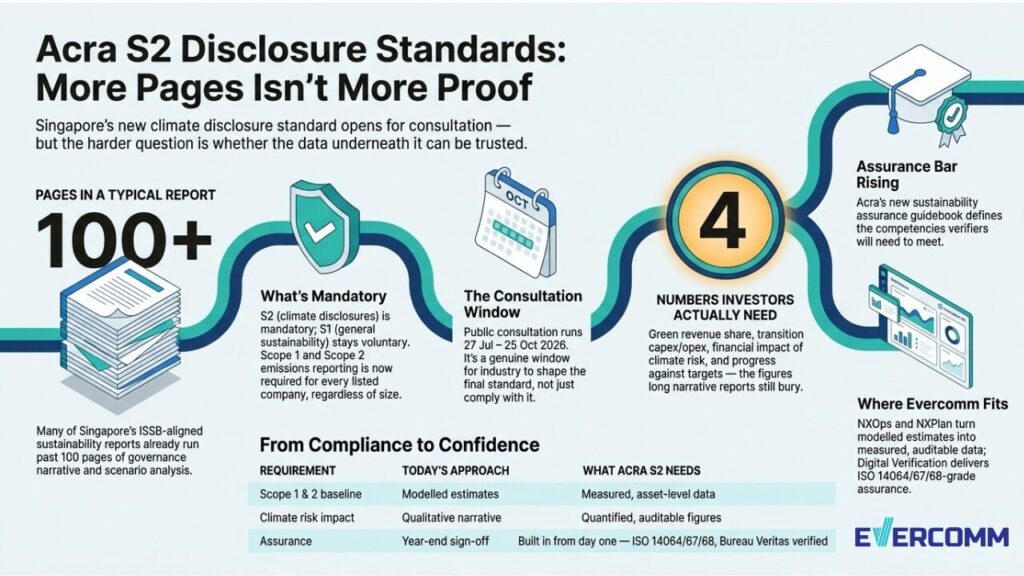
Meeting the Acra S2 disclosure standards well — not just meeting them on paper — is a different exercise from writing a longer report. If the problem is infrastructure rather than intent, the fix looks less like better writing and more like better instrumentation. Three things need to happen at the same time, and none of them are optional extras layered on top of compliance — they are the compliance.
First, Scope 1 and Scope 2 data needs to move from modelled estimates to measured, asset-level figures — the mandatory floor that now applies to every listed company, not just the largest ones. Second, companies need a repeatable way to quantify transition capex and opex, and the financial impact of climate risk on earnings and assets, rather than describing those in prose. Third, assurance needs to become a core competency built in from the start of the reporting cycle, not a year-end sign-off — which is precisely the gap Acra’s new sustainability assurance guidebook is trying to close by defining what “competent” assurance work actually looks like.
Companies that treat these three as sequencing — disclose first, worry about data quality later — will find themselves rebuilding their reporting process from the ground up once the assurance bar rises. Companies that build measurement and verification into the process now will simply have less to redo.
The gaps the second Business Times article names map with unusual precision onto how Evercomm’s own work is structured against the Acra S2 disclosure standards. For the Scope 1 and Scope 2 baseline problem — now a mandatory floor for every listed company regardless of tier — real-time, asset-level operational monitoring through NXOps replaces annual estimation with continuously captured measurement, which is the actual precondition for the kind of quantitative, comparable figures investors are asking for. For the harder ask — quantifying the financial impact of climate risk and the capex or opex earmarked for transition — NXPlan models decarbonisation pathways against cost and investment trade-offs, turning what is currently qualitative scenario narrative in most reports into a modelled, defensible number.
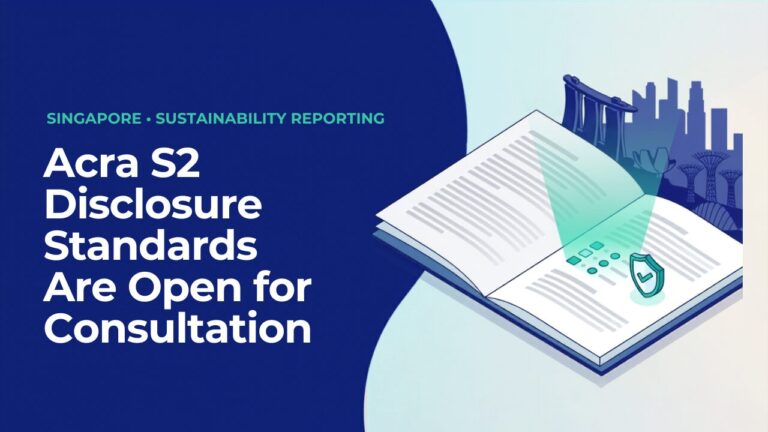
\It’s worth pausing on what the Acra S2 disclosure standards actually achieve, because it’s easy to fixate on the gap and miss the progress. A climate-first mandatory S2, a Scope 3 relief calibrated to where most companies’ data capability realistically sits, and a compliance statement with real teeth — this is a well-built standard, not a box-ticking exercise. It follows the same disciplined playbook Singapore ran with IFRS convergence between 2002 and 2018: adopt the global standard, adjust deliberately for local readiness, and hold the line on the parts that matter.
Singapore isn’t reacting to sustainability reporting from the outside. It’s building its own standard, on its own terms, with the same care it once brought to becoming an IFRS-aligned financial hub — and the consultation window running to 25 October 2026 is a genuine invitation to shape the rules rather than simply comply with them. For companies already living inside ISSB-style disclosure since the TCFD days, this is a chance to weigh in. For the many more companies still ahead of their FY2028 or FY2030 mandatory dates, there is real runway to build the underlying data and assurance capability properly, rather than scramble for it later.
Getting from “what to disclose” to “disclosures worth trusting” is a multi-year, ecosystem-wide effort — better data collection, more robust quantification methodologies, higher standards for what counts as decision-useful. Acra has just taken a serious, credible step toward leading that effort in Asia. That’s worth some quiet confidence, and it’s a good moment for Singapore’s sustainability reporting ecosystem.

Evercomm is a multi-award winning engineering and technology company helping industries build resilience, unlock growth opportunities and navigate the evolving regulations landscape across carbon, energy, waste, and beyond.
Since 2013, we have been helping businesses optimise resource efficiency, reduce carbon emissions, manage climate risk scenarios, and meet international compliance standards ensuring long-term operational and financial sustainability.
Our advanced planning and simulation tools provide precision-driven carbon, energy and waste reduction strategies tailored to your unique operations. Grounded in internationally recognised ISO Standards, Evercomm ensures data integrity, credibility, and verifiability in emissions reduction tracking and reporting. By integrating globally recognised compliance frameworks, including GRI, SBTi, ISSB, and ESRS, we enable organisations to meet stringent regulatory requirements while reinforcing their business resilience.
As a trusted partner, Evercomm helps businesses turn compliance obligations into strategic advantages ensuring they stay ahead in a rapidly shifting economic and regulatory environment.