
Login


08/09/2026
Category
General
On 7 September — Clean Air Day — the United Nations published the most thorough attempt yet to answer a simple question: is cleaning up the air and the climate worth the money? The answer was yes, by a wide margin. A shadow carbon price is the tool that lets one company act on that finding without waiting for anyone else.
Burning fossil fuels does two kinds of damage at once. It warms the planet — slowly, globally, and mostly in the future. And it fills the air with tiny particles that people breathe — quickly, locally, and right now. These are usually treated as two separate problems by two separate government departments with two separate budgets. The argument is that they are one problem with one set of fixes, and that we have been badly underestimating the payoff by pricing them separately.
When you count both together, the numbers change dramatically. You can read the full assessment on the UNEP report page.
Three details make the finding hard to argue with.
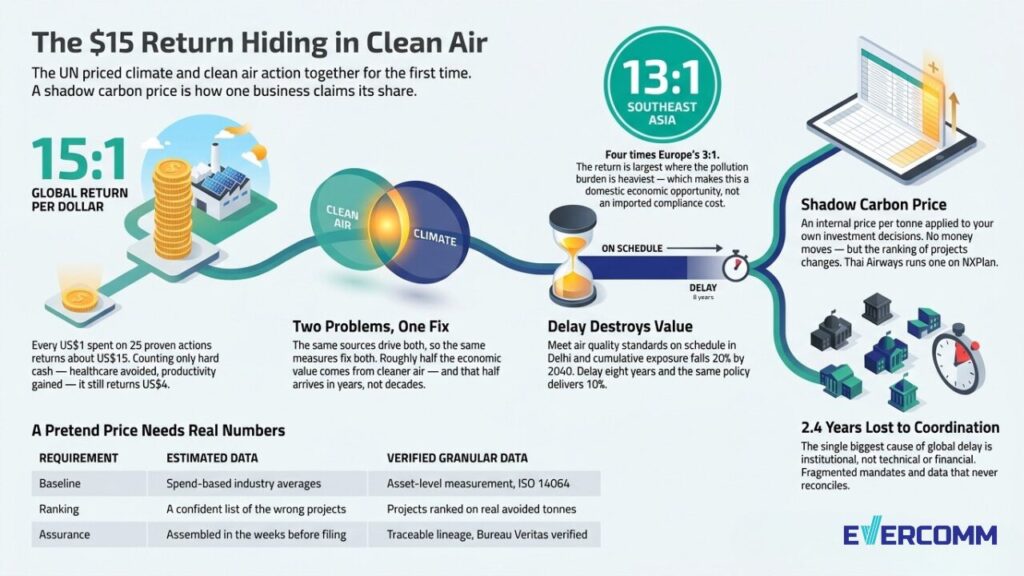
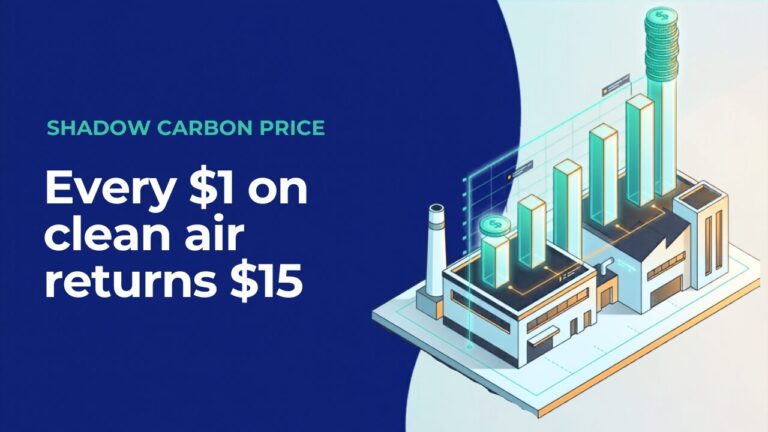
The headline is 15:1 — spend a dollar, get fifteen back. Some of that fifteen is what economists call non-market value: what it’s worth to not have asthma, or to live longer. Reasonable people argue about how to put a number on that.
So strip all of it out. Count only money that moves: healthcare spending avoided, productivity gained, physical damage prevented. The return is still $4 for every $1. That is a better return than most infrastructure a government will ever build.
The whole package runs about 0.7% of global GDP over the next decade. That sounds enormous until you set it beside the bills already being paid: the world spends 2.18% of GDP subsidising fossil fuels, 3.5% on education and 9.3% on healthcare.
In other words, the ask is roughly a third of what governments already spend making the problem cheaper.
By 2035, the money saved on healthcare and gained in productivity from cleaner air alone is greater than the total cost of all 25 actions — before counting a single dollar of anything harder to measure. This is not a “grandchildren will thank you” investment. It clears its own cost inside ten years.
The global average hides an enormous spread, and it runs the opposite way to where most of the pressure comes from.
| Region | Return per $1 | Cash-only return |
|---|---|---|
| Southern Africa | $26 | — |
| South Asia | $21 | $6 |
| Centrally-planned Asia | $18 | $3 |
| Southeast Asia | $13 | $4 |
| EU / EFTA / UK | $3 | — |
Southeast Asia returns roughly four times what Europe does. Not because Asian companies are better at this — because the return is largest where the damage is worst. Regions carrying the heaviest pollution burden have the most harm available to avoid.
That flips a familiar story. Climate rules have mostly arrived in Asia as imports: European supply-chain requirements, international disclosure standards, lenders applying frameworks written somewhere else. Imported rules feel like a cost. A 13:1 return is not a cost — it is a domestic economic opportunity that belongs to the operator, not the regulator.
Two findings sharpen this for anyone making a business case here.
The economic value of avoided air pollution damage is larger than the value of avoided climate damage in the early years, and it is still around 45% of the total in 2100.
We normally describe cleaner air as a nice side effect of climate action. It is closer to half the reason to act — and it is the half that shows up inside a normal business planning horizon, in sick days not taken and hospital admissions that don’t happen.
For anyone building the internal case for an energy upgrade, that is useful. Leading with health and productivity rather than tonnes of CO₂ is now the position with the stronger evidence behind it.
The report’s clearest example is Delhi. Meet India’s air-quality standards on schedule from 2026, and Delhi’s cumulative pollution exposure falls 20% by 2040. Delay by eight years — the global average — and the same policy delivers 10%.
Same rules, same endpoint, half the benefit. The difference is gone permanently, because the people who developed asthma during the delay have already developed it. You can reschedule a construction project. You cannot reschedule the years someone spent breathing.
Here is where a global report becomes something a single company can use.
A shadow carbon price is a pretend price with real consequences.
You decide that from now on, every investment proposal inside your business carries an extra line: the cost of the pollution it creates, at a price you set yourself. Nobody charges you this. No money moves. You simply put it in the spreadsheet next to the capital cost and the running cost.
Then you watch what happens to the ranking.
A boiler upgrade that looked mediocre on energy savings alone moves up the list once you count the emissions it avoids. A bigger, more visible expansion project moves down. Nothing about the engineering changed. The comparison did — because you widened what the comparison counts.
This is exactly the move the UN made, just at a different scale. The 15:1 exists because the authors counted damage that normal accounting ignores. And they counted more of it than anyone had before: earlier studies priced only deaths from air pollution, while this one priced illness too. Roughly one in five cases of major chronic disease traces back to air pollution — 22% of childhood asthma, 21% of chronic lung disease, 20% of heart attacks and strokes.
Widening the boundary of what gets counted is what made the answer four times bigger than previous estimates. A shadow carbon price does the same thing inside one company’s books.
This is not theoretical, and the clearest example in the region is an airline.
In 2025, Thai Airways International built the THAI Sustainability Platform with Evercomm and implementation partner Teo Hong Silom. Most of it is unglamorous plumbing: emissions across the whole business measured automatically to ISO 14064-1 and Thai national standards, pulled directly from the airline’s finance, HR and operations systems, so that every report the airline files comes from the same underlying dataset instead of four different spreadsheets.
But sitting on top of that plumbing is a shadow carbon price. THAI applies an internal carbon cost to its own investment decisions, tracked alongside normal financial measures like NPV and IRR through NXPlan. Emissions reduction projects get ranked in the same language the finance team already uses for everything else.
Two things make this smart rather than merely virtuous.
It is a rehearsal for a bill that is coming. Carbon pricing regimes across Asia are still forming. A company that has been shadow-pricing for three years by the time a real price arrives has already made three years of correctly-ranked decisions. Everyone else starts from zero, under time pressure.
And it only works because the numbers are trustworthy. THAI’s platform can trace any published figure back through every conversion and assumption to the original document or meter reading, with third-party verifiers given direct access to check it.
That matters more than it sounds. You cannot price a tonne you cannot trace. Apply a shadow carbon price to estimated emissions and you get a confidently ranked list of the wrong projects — which is arguably worse than not ranking them at all.
There is a second lesson in Jebsen & Jessen Group’s 2026 sustainability report, and it is easy to miss.
Across eight business units in fourteen countries, the group stayed carbon neutral on its direct emissions while total energy use rose 12.5% — because it was acquiring companies. It did that in two very different ways at once.
It bought 50,053 tonnes of carbon credits. And it did structural work: solar installed across its Packaging business, and in Vietnam, 11,384 tonnes of biomass fuel replacing coal at a manufacturing site.
In an annual report, both look the same — tonnes handled. Under a shadow carbon price, they look nothing alike. Credits are a recurring payment that returns nothing to the business. The Vietnam fuel switch permanently changes what that site emits, cuts local air pollution and CO₂ at the same time, and is precisely the kind of action the UN report identifies as highest-return in developing Asia.
One is an expense. The other is an investment with a measurable return. Telling them apart requires data at the level of the individual site — and that distinction is invisible in a group-level total.
The UN report’s closing recommendation is more useful than its headline. It asks governments to treat air quality monitoring and emissions records as core economic infrastructure, not scientific overhead — because improving the measurement is what changed the economic answer.
It also puts a number on what’s actually holding things up. Surveying 120 experts across China, India, Mexico and Nigeria, the report finds the world is running about 7.5 to 8 years behind, and breaks down why: institutional problems account for 2.4 years, economic 2.2, technical 1.8, social 1.8.
Read that again. The single biggest cause of delay is not technology and not money. It is that the 25 fixes sit under six different ministries that don’t coordinate. Sorting that out alone is worth up to US$10 trillion in health benefits by 2040 — roughly what the entire world spends on healthcare in a year.
Anyone who has tried to build an emissions baseline across a multi-site business will recognise the corporate version of this. The failure is almost never bad arithmetic. It is correct arithmetic done in four departments, on four spreadsheets, in four sets of units, with four versions of the same emission factor, on four different schedules. Nobody is wrong. The filing system is.
That is the layer Evercomm has spent since 2013 building — emissions and energy data verified to ISO 14064, validated by Bureau Veritas, and recognised by Singapore institutions. Granular Data provides the traceable baseline. Assurance provides the independent assessment and verification for organisations that need a defensible starting point before committing capital.
It is the same sequence the UN followed: measure properly first, because the measurement determines the answer.
That sequence is also why Evercomm and SJ Integrated Solutions signed an agreement in July 2026 to make building decarbonisation finance-ready across Asia — baseline the energy, then optimise it, then keep proving it. The engineering knowledge to fix buildings largely exists. What has been missing is performance data a lender will accept.
It would be easy to read all of this as a clever internal finance technique, and it is one. But the 15:1 return the UN calculated does not get delivered by governments alone.
It is the sum of a very large number of ordinary decisions: which boiler gets replaced, which fuel a factory switches to, which building gets retrofitted first, which supplier gets chosen. Most of those decisions are made inside companies, by people comparing options in a spreadsheet.
If those comparisons leave out the cost of pollution, the world systematically under-invests in exactly the things that produce the 15:1 — and does so one reasonable-looking decision at a time. If the comparisons include it, and the numbers underneath are real, the same decisions start compounding the other way.
The UN’s report is a case for public policy. A shadow carbon price is the same case, made privately, one capital plan at a time. And the clean air it produces is not an abstraction — it is the air outside the plant, breathed by the people who work there and the town that surrounds it.
The honest answer is: not with the price. Start with the baseline.
A shadow carbon price is only as good as the emissions data underneath it, and most organisations discover their data is not yet good enough to rank decisions with. That gap is worth finding out about deliberately rather than three months into a capital plan.
The companies best positioned when carbon carries a real price across Asia will not be the ones that guessed the policy timeline correctly. They will be the ones already making decisions as though the price existed — on numbers that hold up when somebody asks how they were produced.
If you are wondering what a shadow carbon price would change about your next capital plan, let’s talk about what a defensible baseline looks like for your operations.
Granular by default. Verified by design. Sustainable by outcome.


Evercomm is a multi-award winning engineering and technology company helping industries build resilience, unlock growth opportunities and navigate the evolving regulations landscape across carbon, energy, waste, and beyond.
Since 2013, we have been helping businesses optimise resource efficiency, reduce carbon emissions, manage climate risk scenarios, and meet international compliance standards ensuring long-term operational and financial sustainability.
Our advanced planning and simulation tools provide precision-driven carbon, energy and waste reduction strategies tailored to your unique operations. Grounded in internationally recognised ISO Standards, Evercomm ensures data integrity, credibility, and verifiability in emissions reduction tracking and reporting. By integrating globally recognised compliance frameworks, including GRI, SBTi, ISSB, and ESRS, we enable organisations to meet stringent regulatory requirements while reinforcing their business resilience.
As a trusted partner, Evercomm helps businesses turn compliance obligations into strategic advantages ensuring they stay ahead in a rapidly shifting economic and regulatory environment.