
Login


28/07/2026
Category
General
Jebsen & Jessen Group has just released its Sustainability Report 2026, covering full-year 2025 performance across eight distinct business units operating in fourteen countries. It is a document that took genuine organisational effort to produce — not because the group was starting from scratch, but because they chose to go deeper: a first-ever Group-wide double materiality assessment, expanded Scope 3 tracking, a new Group-wide ESG data platform, and a governance structure built to hold the numbers accountable across every geography they touch.
At Evercomm, we are proud to have been part of this journey. This article is our congratulatory note — and an honest account of what sustainability reporting at this scale actually involves.
The 2025 numbers tell a clear story. Jebsen & Jessen maintained carbon neutrality for Scope 1 and 2 emissions — a commitment sustained while the group grew its operations significantly, including acquisitions that expanded energy consumption across the portfolio. Total energy use rose 12.5% between 2024 and 2025, driven by new entities entering the fold.
That growth context matters. Maintaining carbon neutrality while expanding is not a passive achievement. It requires active management: purchasing 50,053 tonnes of carbon credits to offset Scope 1 and 2 emissions from 2024, while simultaneously advancing structural decarbonisation across business units.
The structural work is where the real ambition shows.
The Packaging business unit generated 4,995 MW of renewable energy through on-site solar systems. The Vietnam operations transitioned 11,384 tonnes of biomass fuel to replace coal — a meaningful shift in the emissions profile of a manufacturing-intensive site. The Technology division began transitioning its service van fleet from internal combustion engines to electric vehicles.
These are not disclosure footnotes. They are operational decisions, made across different countries, different energy grids, different regulatory environments — and each one feeds back into the emissions data that the report is built on.
On the social side: 82% employee satisfaction across the group. 33% female representation. Zero fatalities across all operations. Over SGD 600,000 invested in health and safety programmes. These numbers represent a workforce of thousands, distributed across Asia, the Middle East, and beyond — and they reflect the same disciplined approach to governance that runs through the environmental data.
The governance results are equally clear: zero confirmed corruption cases, zero significant regulatory non-compliance, 23% year-on-year revenue growth. A group that is performing financially while building sustainability infrastructure — not trading one for the other.
Anyone who has tried to consolidate ESG data across a multi-country industrial group will recognise what this sustainability reporting exercise represents.
Jebsen & Jessen operates across eight distinct business units: Packaging, Ingredients, Technology, Industrial Engineering (JJ-Lurgi), GMA, MSM, Holdings, and Cable Technology (JJ-LAPP). Their operational footprint spans Australia, Brazil, China, Germany, India, Indonesia, Malaysia, Mongolia, Myanmar, the Philippines, Saudi Arabia, Singapore, Thailand, the UAE, the United States, and Vietnam.
Each business unit has a different operational model. Different energy sources. Different local regulations. Different baseline years, different measurement approaches, and — before the work of this report — different levels of sustainability data maturity.
The 2025 report is the first time Jebsen & Jessen completed a Group-wide double materiality assessment: a structured process that identifies not only which sustainability topics are financially material to the Group, but also which of the Group’s activities create material impacts on people and the environment. This is a demanding exercise. Done properly, it draws on stakeholder engagement, operational mapping, and rigorous prioritisation — the outputs of which then shape the entire strategic framework of the report.
The result: six critical material topics identified for long-term resilience and value creation, each supported by defined targets and action plans at both Group and business unit levels. This is sustainability reporting that feeds strategy, not the other way around.
In parallel, the group expanded its Scope 3 tracking for the first time to include employee commute emissions across the Group — adding a category that requires coordination across every site and every business unit. Scope 1 GHG emissions stood at 27,562 tCO2e. Scope 2 at 53,873 tCO2e. Scope 3 at 12,456 tCO2e. Each of those numbers sits on a data infrastructure that had to be built, validated, and made consistent across fourteen countries.
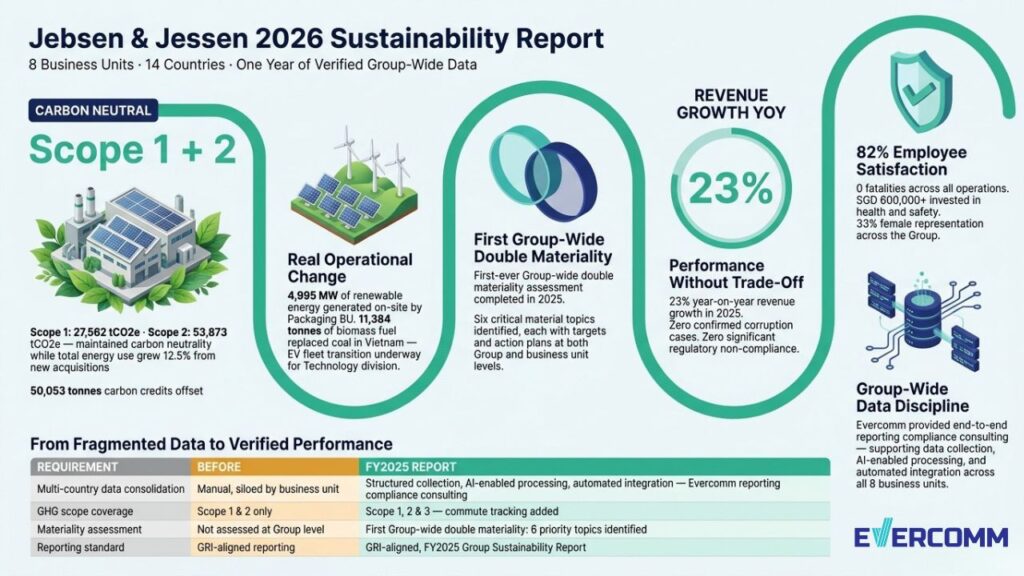
To strengthen data quality and decision usefulness across this complexity, Jebsen & Jessen engaged Evercomm for end-to-end reporting compliance consulting — supporting data collection, AI-enabled data processing, and automated data integration across the Group.
The challenge was real: how do you bring consistency to sustainability data collected across eight business units, fourteen countries, and multiple GHG emission scopes — when those business units have different operational models, different data sources, and different levels of existing infrastructure?
The answer is not to force everything into a spreadsheet. It is disciplined groundwork: structuring how data gets collected at the source, applying AI-enabled processing to handle the volume and variation across sites, and automating the integration that connects a packaging plant in Vietnam to an industrial engineering operation in Germany — on consistent terms.
That is where our work sat. Consolidating sustainability data across eight business units, fourteen countries, and multiple GHG scopes is not a task any single team can do manually with confidence — it requires collection processes, processing, and integration built for that scale.
The work was not a matter of running a script and walking away. It involved close collaboration between Evercomm’s team and the sustainability and operations teams across Jebsen & Jessen’s business units — working through data collection at the source, processing it consistently, and integrating it automatically across the Group.
That collaboration is what makes sustainability reporting credible. Consistent data collection, rigorous processing, and automated integration do not emerge from good intentions. They emerge from the kind of partnership where both parties understand what is at stake.
There is a version of sustainability reporting that is essentially essay-writing. Companies describe their commitments, their values, their aspirations — and publish something that reads well without being anchored to anything verifiable.
Jebsen & Jessen’s 2026 report is not that. Neither is the work we do at Evercomm to support it.
Chairman Heinrich Jessen wrote in his message that the report “provides a balanced and decision-useful view of how sustainability-related matters are being managed today, while transparently outlining areas that will continue to evolve.” That framing — balanced, decision-useful, transparent about what is still developing — is exactly the right orientation for sustainable business practice in 2026.
Progress toward a better world does not start with the best disclosure language. Genuine sustainability reporting starts with the willingness to measure accurately, report honestly, and build the infrastructure that makes accountability possible. That means tracking Scope 3 emissions even when they are hard. It means completing a double materiality assessment even when the process is demanding. It means replacing coal with biomass in Vietnam and ICE vans with EVs in the technology fleet — and building the data systems to prove it.
Jebsen & Jessen has done that work. They have done it across a genuinely complex global operation, with a governance structure designed to hold the results accountable at every level from business unit to Group board.
We believe this is what real sustainability progress looks like. Not a polished report — though the report is well-constructed — but the granular decisions underneath it, verified and traceable, compounding over time into something that actually changes the numbers.
Evercomm’s mission is to power that kind of work. Built in Singapore. Anchored in Asia. Aligned with the organisations that are doing the real thing.
Congratulations to the Jebsen & Jessen team on a significant milestone. The report is a foundation worth building on.
The Jebsen & Jessen Group Sustainability Report 2026 is aligned with the Global Reporting Initiative (GRI) Standards, covering the period 1 January to 31 December 2025. Evercomm’s ESG data platform is verified to ISO 14064 and powered by the Nx-Engine, deployed across industrial and financial sector clients in Asia.
Ready to build the data infrastructure underneath your next sustainability report?
Talk to the Evercomm team — Granular by default. Verified by design. Sustainable by outcome.



Evercomm is a multi-award winning engineering and technology company helping industries build resilience, unlock growth opportunities and navigate the evolving regulations landscape across carbon, energy, waste, and beyond.
Since 2013, we have been helping businesses optimise resource efficiency, reduce carbon emissions, manage climate risk scenarios, and meet international compliance standards ensuring long-term operational and financial sustainability.
Our advanced planning and simulation tools provide precision-driven carbon, energy and waste reduction strategies tailored to your unique operations. Grounded in internationally recognised ISO Standards, Evercomm ensures data integrity, credibility, and verifiability in emissions reduction tracking and reporting. By integrating globally recognised compliance frameworks, including GRI, SBTi, ISSB, and ESRS, we enable organisations to meet stringent regulatory requirements while reinforcing their business resilience.
As a trusted partner, Evercomm helps businesses turn compliance obligations into strategic advantages ensuring they stay ahead in a rapidly shifting economic and regulatory environment.