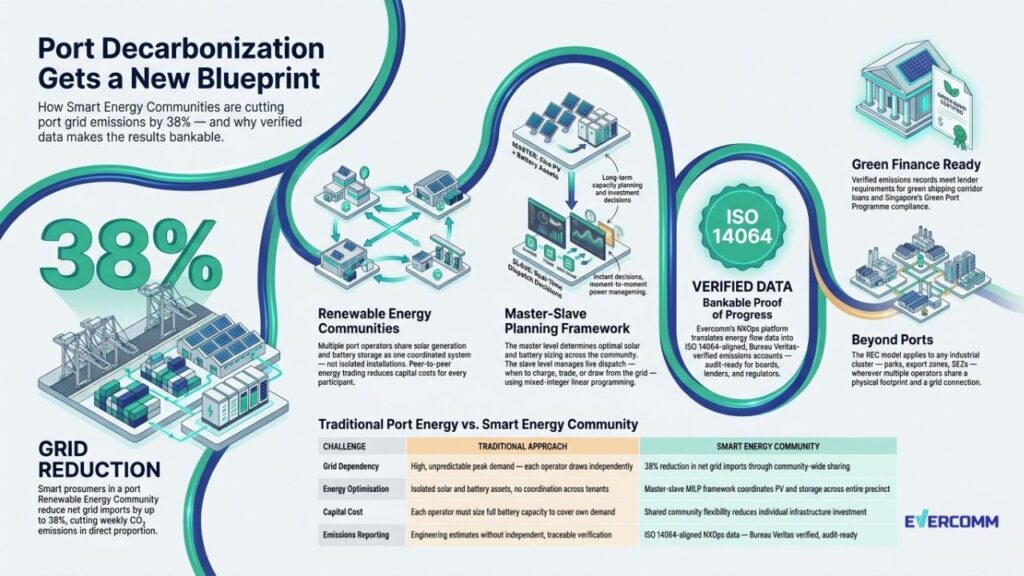
Ports are the unseen engine of global trade — and one of the most stubborn challenges in Asia’s industrial decarbonization agenda. A container port running around the clock consumes enormous amounts of electricity, operates heavy machinery across vast sites, and manages energy demands that shift minute by minute with vessel arrivals, cargo loads, and logistics flows. Achieving meaningful port decarbonization in this environment isn’t purely an engineering challenge. It is a data challenge.
New peer-reviewed research published in
Energy — one of the most respected journals in the field — offers a significant step forward. Co-authored by Professor Stefano Mazzoni and Lorenzo Bartolucci of the University of Rome Tor Vergata, the study demonstrates that port-centric Renewable Energy Communities built around smart prosumers can reduce net grid imports by up to
38%, while measurably cutting weekly CO₂ emissions. Evercomm is collaborating with Professor Mazzoni to bring this technology into industrial deployment across Asia — where verified carbon intelligence turns these results into data that boards, lenders, and regulators can act on.
Why Port Decarbonization Has Been So Hard to Solve
Most industrial decarbonization programs start with factories, data centres, or commercial buildings — sites where energy loads are relatively predictable and sub-metering is straightforward. Ports are different.
Port energy demands are intermittent, heterogeneous, and spread across a physical footprint that can span several kilometres. Cold-ironing infrastructure for berthed vessels, crane systems, warehouse refrigeration, lighting, and logistics vehicles all draw on the same grid connection. These loads don’t follow a neat daily schedule. They spike when a vessel berths, flatten when a berth empties, and shift constantly across shifts, tides, and seasons.
Traditional approaches to port decarbonization — rooftop solar panels on terminal sheds, or electrifying individual pieces of diesel equipment — reduce emissions incrementally but don’t solve the coordination problem: how do you optimise energy flows across an entire port precinct, involving multiple tenants and operators, without creating grid instability or stranding renewable capacity?
This is precisely the problem the Mazzoni-Bartolucci research addresses — and solves.
The Technology: Smart Prosumers and Renewable Energy Communities
The research introduces a framework built around Renewable Energy Communities (RECs) — a model in which multiple energy users within a defined geographic area collectively produce, consume, share, and manage energy as a coordinated system, rather than each acting independently.
Within a port REC, some participants are “smart prosumers”: facilities equipped with rooftop solar photovoltaic systems, battery energy storage, and the intelligence to decide in real time whether to consume their own generation, store it, trade it to a neighbour, or draw from the external grid. Other participants may be pure consumers who benefit from peer-to-peer energy trades without installing generation assets of their own.
The system is governed by a master-slave planning framework — a hierarchical optimisation model that operates simultaneously at two levels:
→ Master level: Determines the optimal size and configuration of PV and battery assets across the community during the planning phase. How much solar capacity to install at each location, how large the batteries should be, and how prosumer portfolios should be structured for maximum community benefit.
→ Slave level: Manages real-time dispatch decisions — when to charge batteries, when to sell energy to neighbouring operators, when to draw from the grid — based on live generation forecasts, demand patterns, and energy prices.
The framework uses mixed-integer linear programming (MILP) to solve both levels together. The result is a port energy community that doesn’t just reduce emissions through on-site renewable generation — it reduces them through intelligent, system-wide coordination.
What the Research Proves
The published findings are specific and striking in their implications for port decarbonization.
As prosumer participation in the port REC increases, net grid imports fall by up to 38%. This means that more than a third of the electricity the port complex would have drawn from the national grid — electricity generated, in much of Asia, predominantly by fossil fuels — is instead sourced from within the community itself, from solar arrays and batteries owned by port operators and tenants.
Weekly CO₂ emissions fall in proportion. The grid exchanges that remain are smaller in volume and variability, reducing the peak demand charges that industrial operators typically pay. And because prosumers share and balance generation capacity across the community, each operator requires less dedicated battery infrastructure than they would need acting alone — lowering the capital cost of decarbonization for every participant.
The research also identifies an important inflection point: aggregation benefits grow with prosumer participation but begin to diminish once the community’s collective flexibility becomes saturated. This is a practical planning insight — it points to an optimal prosumer penetration rate rather than simply advocating for maximum solar and battery deployment. Port developers and energy planners can use this to size their REC investments with precision rather than optimism.
The methodology is published and peer-reviewed in a leading scientific journal — the University of Rome Tor Vergata has a long record in energy systems research, and Professor Mazzoni’s work bridges academic rigour with industrial applicability. This isn’t a demonstration project. It is a mathematically validated planning framework ready for real-world deployment.
Port Decarbonization and the Verification Gap
Here is the part that rarely appears in academic publications but matters enormously for industrial operators: the emissions reductions this framework produces are only as valuable as the data that independently proves them.
A port authority that reduces grid imports by 38% has achieved something real and significant. But to a lender evaluating eligibility for a green shipping corridor loan, or a regulator assessing emissions disclosures under the IMO’s 2050 net-zero framework, or a board reviewing Scope 2 performance against a publicly stated net-zero target — a claim is not enough. What they require is verified, traceable, ISO-aligned emissions data: numbers that have been measured at the meter level, reported transparently, and independently confirmed.
This is the gap Evercomm fills in the collaboration with Professor Mazzoni.
Evercomm’s NXOps platform provides real-time operational emissions monitoring built for the complexity of multi-tenant industrial sites. It integrates with existing site infrastructure and data sources, capturing the energy flows that a port REC generates — solar generation output, battery charge and discharge cycles, peer-to-peer energy trades, net grid imports — and translating them into ISO 14064-aligned emissions accounts. Every data point is traceable. Every figure is audit-ready.
Where the Mazzoni-Bartolucci framework optimises energy flows, NXOps certifies what happened and what it means in carbon terms. The combination is what makes port decarbonization progress bankable.
For port operators seeking access to green finance instruments, complying with Singapore’s Green Port Programme, meeting the requirements of lenders who track Scope 2 performance, or responding to board-level demands for verified ESG data — optimisation without verification is still an incomplete story. ISO 14064-aligned, Bureau Veritas-verified data turns an energy engineering result into evidence that withstands scrutiny.