What the Panel Revealed: Three Questions That Mattered
At the SCTF sharing session, Panel 1 focused on the objectives and benefits of TR 149. The formal discussion covered the standard’s development rationale, its tiered approach, and how it aligns with Singapore’s broader sustainability strategy.
The Q&A told a more instructive story.
Three questions — not for their complexity, but for what they revealed about where Singapore businesses are in their sustainability thinking.
“Is this recognised under government tenders and procurement?”
This question received the highest audience vote of any submitted through the event platform. It reframes TR 149 certification not as a compliance exercise but as a market access question. Businesses aren’t asking whether they should care about sustainability. They’re asking whether caring will actually open doors. Recognition in government procurement would be a meaningful signal — and one that the working group’s relationship with Singapore Standards Council and Enterprise Singapore positions TR 149 to potentially deliver.
“How much would certification typically cost? Would government consider providing grant support?”
A technical reference designed for SMEs that costs as much to certify against as a full ISO standard defeats its own purpose. Cost is the most common reason sustainability frameworks fail to achieve uptake among smaller enterprises — not disinterest, but inaccessibility. Grant mechanisms through Enterprise Singapore or sector-specific bodies could change this arithmetic significantly, and the question showed that businesses are ready to move if the financial barrier is addressed.
“The standard looks very in depth but highly qualitative. How do we ensure minimal deviation within each band?”
This was the most technically substantive question of the session. TR 149’s tiered structure is a strength, but its qualitative nature creates a legitimate implementation challenge: two organisations at the same tier may be doing very different things, with very different data quality behind their claims. Consistency of assessment across certification bodies, and clarity on what evidence satisfies each band, is a question the TR 149 working group will need to address as adoption scales.
From Awareness to Action: What This Means for SMEs Starting Now
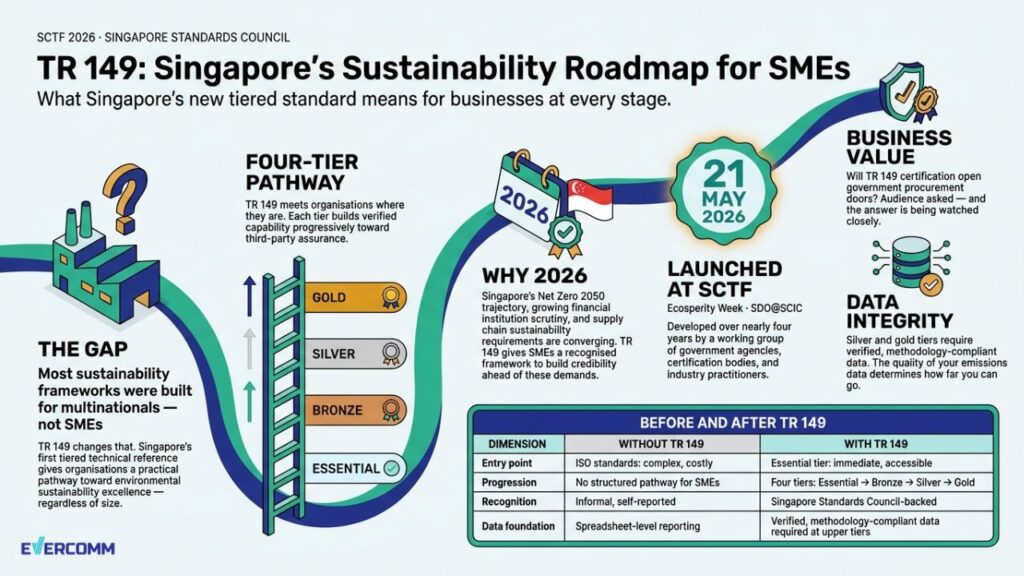
TR 149 is most useful when understood not as a regulatory burden but as a strategic planning instrument. The essential tier gives any organisation — including those with no prior sustainability programme — a credible starting point. The progression to bronze, silver, and gold gives leadership a visible roadmap to present to boards, customers, and lenders.
For SMEs that haven’t begun their sustainability journey, TR 149 answers the hardest question: where do I start, and what does doing this properly look like?
For businesses already measuring emissions, tracking energy consumption, or beginning reduction programmes, TR 149 provides a Singapore-recognised framework to contextualise that work. Effort that currently lives in spreadsheets or internal reports can be mapped against TR 149 requirements, assessed for tier-level, and built toward formal certification.
The alignment between TR 149 and Singapore’s broader climate strategy — Net Zero 2050, the Carbon Markets Cooperation Agreement, the growing expectation from financial institutions for supply chain emissions transparency — is deliberate. Businesses that adopt TR 149 now are building the capability to meet requirements that will become more pressing over the next five years, not less.
The Foundation Underneath
For TR 149 to deliver on its promise — particularly at the silver and gold tiers — the data underneath needs to hold up. This is the practical implication of that third audience question about qualitative standards and consistency.
At the bronze tier, documented processes may be enough. By silver, measurement matters. By gold, third-party assurance requires that the numbers being assured are real, traceable, and methodology-compliant.
TR 149 is a framework for how organisations progress. But high-integrity emissions data is the foundation that framework stands on.
Evercomm’s
Robert Field-Marsham participated in the TR 149 working group in his individual capacity as a sustainability practitioner — one of the practitioners who shaped the framework over nearly four years. His presence on the panel reflected the technical depth the working group brought to TR 149’s development.
At Evercomm, we have spent over a decade building the data infrastructure that makes sustainability credible: AI-powered emissions monitoring verified to ISO 14064, recognised by Bureau Veritas, and accepted by Singapore banks and government agencies. The organisations moving toward TR 149 silver and gold will need data that meets that standard of assurance.
TR 149 is Singapore’s sustainability roadmap for SMEs. High-integrity data is the ground it needs to be built on.
If your organisation is exploring what TR 149 means in practice — where you currently sit against each tier, and what it would take to progress.
Let’s chat.
TR 149 was launched on 21 May 2026 at the Singapore Chemical Technology Forum (SCTF), hosted by the Standards Development Organisation at the Singapore Chemical Industry Council (SDO@SCIC). The technical reference was published by the Singapore Standards Council and developed in partnership with Enterprise Singapore.