In a frank conversation on Money FM 89.3’s Under the Radar, Evercomm co-founder and CEO Ted Chen explains why transition finance in Asia demands engineering precision — not ESG ambition.
The phrase “net zero” has been losing altitude. Even in Europe, where sustainability has long been front-facing, major banks are withdrawing their net zero commitments. Geopolitical pressures, energy security concerns, and rising pragmatism have shifted the conversation.
Yet Ted Chen, co-founder and CEO at Evercomm Singapore, isn’t rattled. Speaking to Money FM 89.3’s Chua Tian Tian on the *Under the Radar* podcast, he made a point that cuts through the noise: transition finance in Asia is not dying with the net zero narrative. If anything, it is maturing.
“Energy security, water security, food, waste — all these continue to remain very important critical infrastructure for every country,” Ted told Chua Tian Tian. “We really focus more on these pieces than ESG in general.”
This is not a retreat. It is a recalibration — and it reflects a more honest, more durable version of what the decarbonisation journey in Asia actually looks like.
What Evercomm Does — And Why It Matters for Transition Finance
Founded in 2013 and headquartered in Singapore,
Evercomm sits at the intersection of industrial engineering and financial services. That’s not a common position to hold, and Ted acknowledged it takes deliberate framing to explain.
The company’s core technology was developed through a 6-7 year research collaboration with Nanyang Technological University (NTU), and was already being piloted at Jurong Port and the Punggol Digital District before reaching commercial scale. That heritage matters. It means Evercomm’s solutions were tested in the real complexity of industrial operations — not built in a lab and retrofitted.
What this translates to in practice is a product suite focused on two interconnected problems:
1. Compliance reporting — helping companies and banks produce verified, ISO-aligned emissions reports that hold up under scrutiny from regulators, credit committees, and auditors
2. Simulation and planning — helping enterprises and financial institutions model decarbonisation pathways and identify which projects are both green *and* economically viable
The second piece is where transition finance enters the picture. “The project still needs to make economic sense,” Ted said plainly. “If the project is purely green and doesn’t really make economic sense, there’s nothing that we can do to push the financing.”
For transition finance in Asia to work at scale, this is the honest constraint that practitioners must start from — not the aspirational target.
Why Banks Are the Real Gateway to Transition Finance in Asia
One of the clearest insights from Ted’s conversation with Chua Tian Tian was a shift in how Evercomm thinks about its go-to-market strategy. The company serves two distinct customer segments: industrial enterprises such as Thai Airways and Mitsubishi, and financial institutions including banks, family offices, and funds. But Ted made clear that the financial sector now anchors the entire approach.
“When we go to an industrial customer, it’s much easier to go to them through an introduction from the banks than to directly approach,” he said.
This logic reshapes what transition finance in Asia actually requires. Banks are not passive funders waiting for a green project to appear. They are the channel through which capital flows to the industrial sector. If those banks lack the tools to assess the decarbonisation impact of a loan, transition finance stalls at the source.
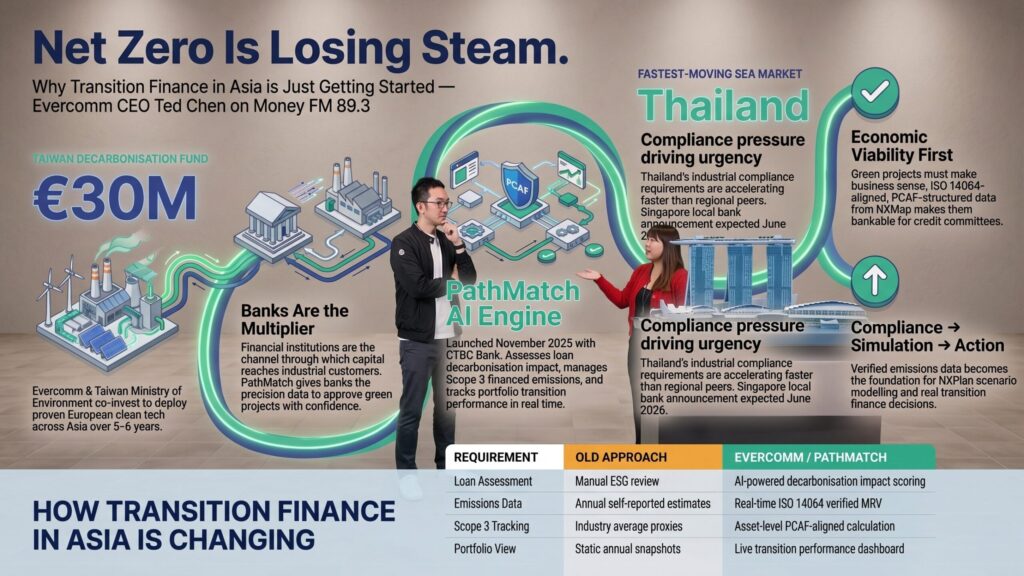
Evercomm’s response is its NXPlan and NXMap products — the planning and emissions mapping tools that allow banks and their industrial clients to model scenarios, quantify impact, and build a bankable case for sustainable investment. NXPlan handles transition scenario simulation. NXMap visualises emissions across assets and geographies. Together, they give banks the precision data that credit committees need before approving a transition finance transaction.
Customers like Mitsubishi Electric and Thai Airways represent the industrial side of the equation. CTBC Bank, one of Evercomm’s earliest and most significant partners, represents the financial gateway that makes transition finance flow from intention into action.
PathMatch: The AI Engine at the Heart of Transition Finance
In November 2025, Evercomm and CTBC Bank unveiled PathMatch — a jointly developed AI-powered transition finance engine. The product targets a precise problem: how do banks assess the decarbonisation impact of a loan, manage Scope 3 financed emissions, and track portfolio transition performance in real time?
For CTBC Bank, the context is significant. The bank chairs the Asia-Pacific arm of key financial institution compliance standards, making it both an influential early adopter and a credibility signal for other institutions watching how transition finance frameworks develop in the region.
PathMatch is built to answer the questions that credit committees are beginning to ask — and will increasingly be required to answer.
- Can this project demonstrate a measurable decarbonisation pathway?
- Is the emissions data verifiable to ISO standards?
- How does this loan affect the bank’s financed emissions portfolio under PCAF (Partnership for Carbon Accounting Financials)?
These are not theoretical questions. Regulatory requirements around climate risk, capital transition, and Scope 3 financed emissions are tightening across Asia-Pacific, driven by frameworks including
IFRS S2, CSRD, TCFD, and MAS guidelines. Transition finance practitioners need tools that produce bankable outputs — not just sustainability reports that sit in a drawer.
Ted confirmed that PathMatch marks the start of a broader regional roll-out. Speaking with Chua Tian Tian, he signalled that local Singapore banks are now in active discussions. “We started with CTBC being a Taiwan bank,” he said. “Now coming to Singapore, we already started to talk to local banks — and hopefully by June, we will make some announcement.”