

Login

A Transition Plan Is No Longer Optional. Here Is What One Actually Looks Like.

Date

20/04/2026

Category

General

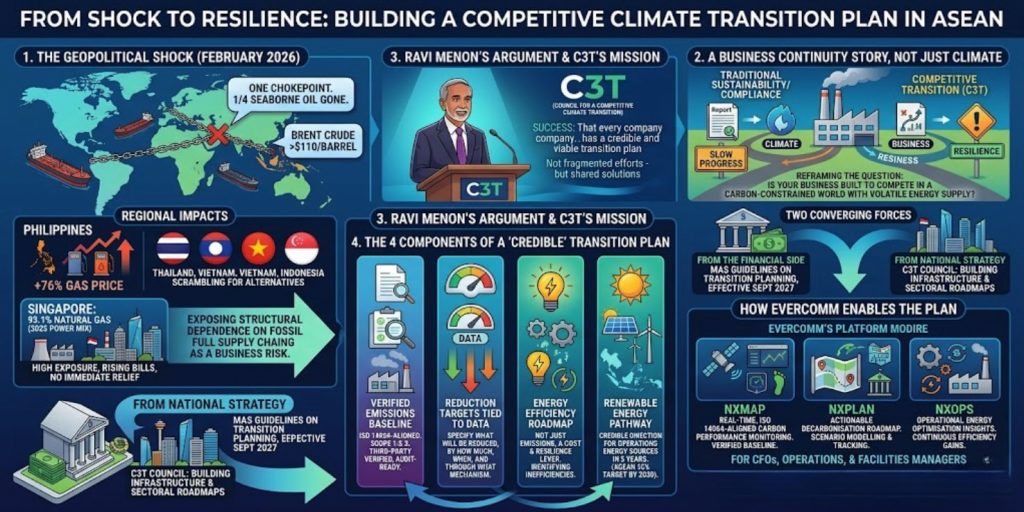
On 28 February 2026, Iran effectively closed the Strait of Hormuz. One chokepoint. One-quarter of the world’s daily seaborne oil — gone.
 
Within weeks, Brent crude crossed $110 a barrel. Petrol prices in the Philippines jumped 76%. Vietnam, Thailand, and Indonesia scrambled for alternatives. And Singapore — where natural gas made up 93.1% of the power mix in 2025 — watched energy bills and contract costs climb with no immediate relief in sight
 
This was not a climate story. It was a business continuity story. And for anyone who had been treating energy transition as a long-term aspiration rather than an operational necessity, it was a very expensive lesson.
 

The Shock That Made It Real

 
The Hormuz closure exposed something ASEAN’s business community had known intellectually but had not yet felt financially: structural dependence on fossil fuel supply chains is a business risk, not just an environmental one.
 
Singapore’s exposure was acute. With 93% of its power generation tied to natural gas — the majority imported — there was no buffer. No diversification to fall back on. Energy bills rose. Long-term supply contracts came under pressure. Companies that had been planning to address energy efficiency “eventually” suddenly found themselves looking at their energy costs with new urgency.
 
This is the context in which Ravi Menon, Singapore’s Ambassador for Climate Action, spoke on 6 April 2026. His message was precise: Renewables and energy efficiency improvements are obvious measures for the long term.’ Not obvious in the sense of easy. Obvious in the sense that the alternative — continued dependence on imported fossil fuels routed through geopolitical chokepoints — is no longer a credible business strategy.


Ravi Menon’s Argument — and What Sits Behind It

 
On 6 April, Singapore launched the Council for a Competitive Climate Transition (C3T), co-chaired by Ravi Menon and Singapore Business Federation CEO Kok Ping Soon.
 
The name is deliberate. Not the Council for Climate Compliance. Not the Council for Emissions Reduction. *Competitive* Climate Transition — because the argument being made is a business argument, not a moral one.
 
Menon defined success for the council plainly:
 

That every company, every business has a credible and viable transition plan in terms of how they’re going to be managing their climate-related risks and in terms of how they are going to transition their business to become more competitive in a carbon-constrained world.
And he was clear about what C3T is not:
 
Not about telling companies what to do. Not about adding another compliance layer. Not fragmented efforts — but shared solutions.
 
This matters for industrial companies because it reframes the question entirely. The ask is not “are you compliant?” The ask is: “Is your business built to compete in a world where carbon costs are real, energy supply is volatile, and your financial counterparties are required to assess your climate risk?”
 
If the answer is “No.” or “We’re working on it” — that is a strategic gap, not a sustainability gap.

What “Credible” Actually Means

 
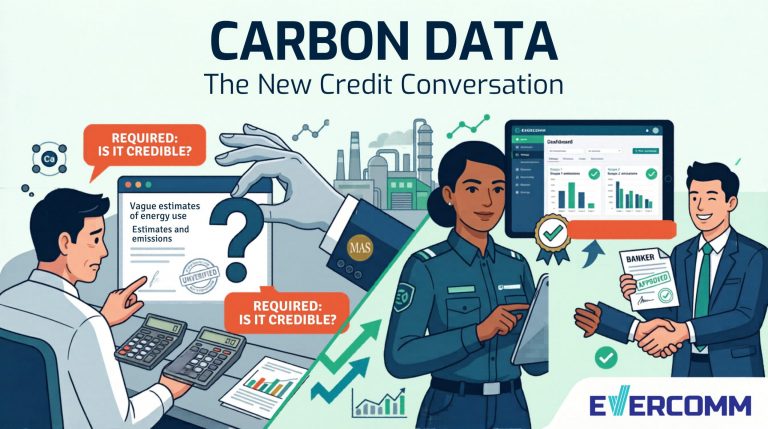
Here is where most companies get stuck. They have pledges. They have sustainability reports. They may even have a net-zero target. But when a bank’s credit committee or a C3T framework asks for a credible transition plan, none of that is sufficient.
 A credible transition plan has four components — each one verifiable, each one actionable:
 
1. A verified emissions baseline

You cannot plan a transition from a position you cannot prove. A credible baseline means ISO 14064-aligned measurement across Scope 1 and Scope 2 emissions — third-party verified, audit-ready, and current. Not last year’s estimate. Not an industry average. Your actual number, measured at your facilities.

2. Reduction targets tied to real data

Targets without baselines are aspirations. Credible targets are built from the baseline — they specify what will be reduced, by how much, by when, and through what mechanism. Energy efficiency improvements, fuel switching, renewable sourcing: each pathway needs data behind it, not narrative.

3. An energy efficiency roadmap

This is where the Hormuz shock makes the business case viscerally clear. Energy efficiency is not just an emissions lever — it is a cost and resilience lever. Companies that have mapped their energy consumption at the facility level, identified inefficiencies, and begun reducing them are not just lowering their carbon footprint. They are reducing their exposure to the next supply shock.

4. A renewable energy pathway

ASEAN has set a target of 45% renewable capacity by 2030. Within that, hydropower is already cost-competitive across parts of Indonesia, Malaysia, Vietnam, and the Philippines. Solar PV is viable in Indonesia, Cambodia, and Vietnam. The pathway does not require perfection — it requires a credible direction: what energy sources will your operations run on in five years, and how are you getting there?

A company that can walk into a conversation with all four of these elements — verified, documented, and current — is not presenting a sustainability report. It is presenting a business plan.
 

Two Signals, One Direction

From the financial side: MAS’s Guidelines on Transition Planning (effective September 2027) require every bank, insurer, and asset manager to run structured climate risk engagement with the companies they serve. They must assess your emissions profile. They must distinguish between companies with credible plans and those without.
 
From the national strategy side: C3T is building the infrastructure to help companies develop exactly those plans — reducing friction, aggregating data, co-developing sectoral roadmaps, unlocking green finance access. Both signals are pointing at the same gap: most industrial companies do not yet have a transition plan that would satisfy either standard.
 
The Hormuz shock, meanwhile, demonstrated what that gap costs in practice — not in 2040, not when carbon taxes bite harder, but now, in 2026, when a single geopolitical event rewrites your energy bill overnight.
The companies that navigated the shock best were the ones that had already reduced their fossil fuel dependence through efficiency investments and renewable sourcing. Not because they anticipated Hormuz. Because they had already started moving.

How Evercomm Enables the Plan


Building a credible transition plan requires data before it requires strategy. You cannot set targets without a baseline. You cannot identify efficiency gains without measurement. You cannot demonstrate progress to a bank or insurer without verified, audit-ready records.

This is precisely what Evercomm’s platform delivers.

NXMap provides real-time, ISO 14064-aligned carbon performance monitoring across your industrial operations — verified by Bureau Veritas, recognised by Singapore government agencies and financial institutions. It gives you the verified baseline that sits at the foundation of every credible plan.

NXPlan translates that baseline into an actionable decarbonisation roadmap. Scenario modelling, reduction pathway analysis, milestone tracking — the tools that turn a data record into a transition plan that holds up to scrutiny.

NXOps keeps the operational picture current — energy optimisation insights that directly support the efficiency gains a credible plan depends on.

For CFOs, this means your transition plan is built on data that your board, your bank, and your insurer can rely on. For operations directors, it maps sustainability performance directly to production efficiency. For facilities managers, it provides continuous measurement with minimal disruption to operations.

The plan does not have to be perfect from day one. It has to be credible, current, and improving. That is what the MAS guidelines ask for. That is what C3T is trying to enable. And that is what Evercomm helps you build.

The Bottom Line


The energy shock that hit ASEAN in early 2026 was a preview — not an anomaly. Geopolitical disruption of fossil fuel supply chains is a recurring risk, not a one-time event. The structural answer, as Ravi Menon argued, is energy efficiency and renewables — not as climate virtue, but as business resilience.

Singapore’s C3T Council is now building the national infrastructure to help companies get there. MAS’s guidelines are ensuring that the financial system rewards those who do.
 
What sits between those two forces is a credible transition plan. Most industrial companies do not yet have one. The window to build it, before both the regulatory and commercial conversations intensify, is open — but it is not permanent.
 
 
Want to see what a verified emissions baseline and transition roadmap look like for your operations? Let’s start the conversation.

Browse More Articles

Credible Transition Plan
A Transition Plan Is No Longer Optional. Here Is What One Actually Looks Like
From the Hormuz oil shock to Singapore's C3T Council — here's what a credible transition plan must contain,...
MAS transition planning
MAS Transition Planning: What Industrial Firms Must Know
MAS's 2026 transition planning guidelines require banks to assess your carbon risk. What industrial companies...
ESG governance and risk management
Beyond the Alphabet Soup: Why Governance and Risk Management Are the New ESG Standard in 2026
ESG success is defined by governance and risk management. Learn how companies are moving beyond ESG frameworks...

Chatbot

Hey there 👋
How can I help you today?