
Login

20/04/2026
General
That every company, every business has a credible and viable transition plan in terms of how they’re going to be managing their climate-related risks and in terms of how they are going to transition their business to become more competitive in a carbon-constrained world.
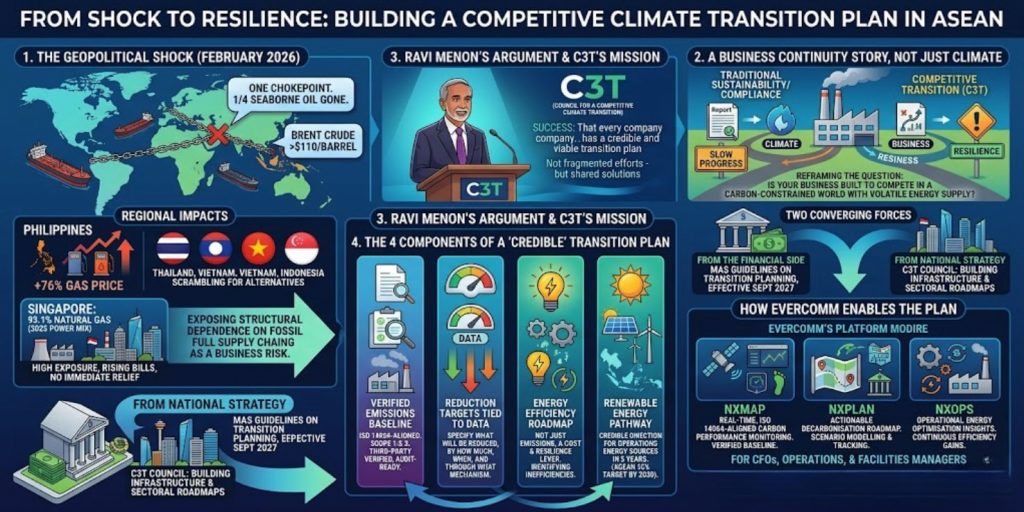
You cannot plan a transition from a position you cannot prove. A credible baseline means ISO 14064-aligned measurement across Scope 1 and Scope 2 emissions — third-party verified, audit-ready, and current. Not last year’s estimate. Not an industry average. Your actual number, measured at your facilities.
Targets without baselines are aspirations. Credible targets are built from the baseline — they specify what will be reduced, by how much, by when, and through what mechanism. Energy efficiency improvements, fuel switching, renewable sourcing: each pathway needs data behind it, not narrative.
This is where the Hormuz shock makes the business case viscerally clear. Energy efficiency is not just an emissions lever — it is a cost and resilience lever. Companies that have mapped their energy consumption at the facility level, identified inefficiencies, and begun reducing them are not just lowering their carbon footprint. They are reducing their exposure to the next supply shock.
ASEAN has set a target of 45% renewable capacity by 2030. Within that, hydropower is already cost-competitive across parts of Indonesia, Malaysia, Vietnam, and the Philippines. Solar PV is viable in Indonesia, Cambodia, and Vietnam. The pathway does not require perfection — it requires a credible direction: what energy sources will your operations run on in five years, and how are you getting there?
Building a credible transition plan requires data before it requires strategy. You cannot set targets without a baseline. You cannot identify efficiency gains without measurement. You cannot demonstrate progress to a bank or insurer without verified, audit-ready records.
This is precisely what Evercomm’s platform delivers.
NXMap provides real-time, ISO 14064-aligned carbon performance monitoring across your industrial operations — verified by Bureau Veritas, recognised by Singapore government agencies and financial institutions. It gives you the verified baseline that sits at the foundation of every credible plan.
NXPlan translates that baseline into an actionable decarbonisation roadmap. Scenario modelling, reduction pathway analysis, milestone tracking — the tools that turn a data record into a transition plan that holds up to scrutiny.
NXOps keeps the operational picture current — energy optimisation insights that directly support the efficiency gains a credible plan depends on.
For CFOs, this means your transition plan is built on data that your board, your bank, and your insurer can rely on. For operations directors, it maps sustainability performance directly to production efficiency. For facilities managers, it provides continuous measurement with minimal disruption to operations.
The plan does not have to be perfect from day one. It has to be credible, current, and improving. That is what the MAS guidelines ask for. That is what C3T is trying to enable. And that is what Evercomm helps you build.
The energy shock that hit ASEAN in early 2026 was a preview — not an anomaly. Geopolitical disruption of fossil fuel supply chains is a recurring risk, not a one-time event. The structural answer, as Ravi Menon argued, is energy efficiency and renewables — not as climate virtue, but as business resilience.



Evercomm is a multi-award winning engineering and technology company helping industries build resilience, unlock growth opportunities and navigate the evolving regulations landscape across carbon, energy, waste, and beyond.
Since 2013, we have been helping businesses optimise resource efficiency, reduce carbon emissions, manage climate risk scenarios, and meet international compliance standards ensuring long-term operational and financial sustainability.
Our advanced planning and simulation tools provide precision-driven carbon, energy and waste reduction strategies tailored to your unique operations. Grounded in internationally recognised ISO Standards, Evercomm ensures data integrity, credibility, and verifiability in emissions reduction tracking and reporting. By integrating globally recognised compliance frameworks, including GRI, SBTi, ISSB, and ESRS, we enable organisations to meet stringent regulatory requirements while reinforcing their business resilience.
As a trusted partner, Evercomm helps businesses turn compliance obligations into strategic advantages ensuring they stay ahead in a rapidly shifting economic and regulatory environment.