Login

PCAF's First Annual Impact Report Is Out. The Numbers Tell a Bigger Story Than Most Banks Realise.

Date

22/04/2026

Category

General

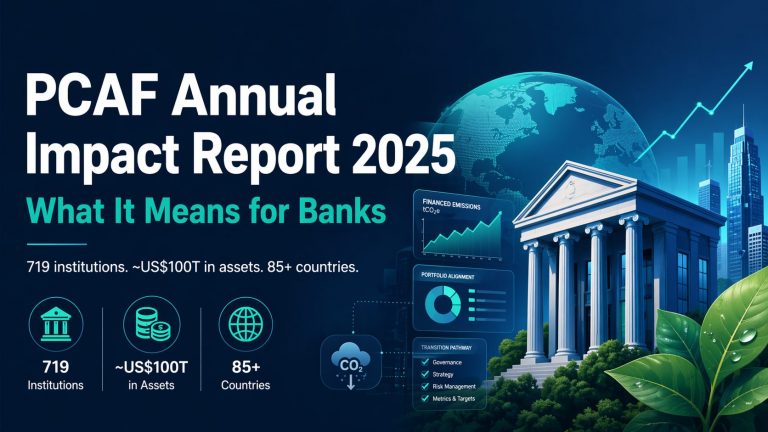
Seven hundred and nineteen financial institutions.
Nearly $100 trillion in assets.
Eighty-five countries.

The Partnership for Carbon Accounting Financials has just published its inaugural Annual Impact Report — and for any bank or financial institution still treating financed emissions as a back-office exercise, this report is a signal worth paying attention to.

The Landscape: PCAF Has Crossed a Threshold

 
Released on 31 March 2026, the PCAF Annual Impact Report is the first of its kind — a public accounting of the organisation’s reach, output, and direction. For a framework that started as a small coalition of Dutch banks in 2015, the scale is striking.
 
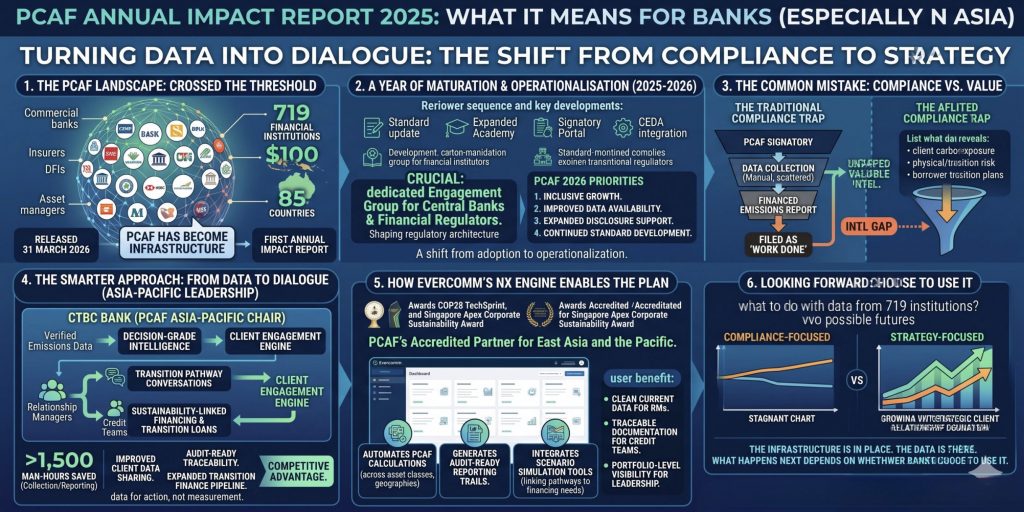
Nearly $100 trillion in assets are now managed by PCAF signatories. The standard has been adopted across more than 85 countries. The community spans commercial banks, insurance companies, development finance institutions, and asset managers — all now aligned to the same methodology for measuring and reporting financed emissions.
 
This is not a niche disclosure exercise anymore. PCAF has become infrastructure.
 
The report also details a year of significant development: an updated Global GHG Accounting and Reporting Standard, an expanded PCAF Academy, the launch of a new Signatory Portal, integration of the Comprehensive Environmental Data Archive into the PCAF Database, and crucially, the establishment of a dedicated Engagement Group for Central Banks and Financial Regulators. That last development signals that PCAF is no longer waiting at the table. It is actively shaping the regulatory architecture around it.
 
Looking ahead, PCAF has outlined four priorities for 2026: inclusive growth, improved data availability, expanded disclosure support, and continued Standard development. Each of these points to the same underlying shift — the framework is maturing from adoption to operationalisation.
 

The Common Mistake: Treating PCAF as a Reporting Obligation

Here is where many financial institutions are still getting it wrong.
 
PCAF compliance tends to land in the sustainability or risk team. The data gets gathered, the numbers get reported, and the document gets filed. The work is done at least on paper.
 
But the value embedded in financed emissions data is almost entirely untapped when this is all it amounts to.
 
Consider what the data actually contains: a granular picture of every client’s carbon exposure, sector by sector, asset class by asset class. It reveals which borrowers are running high-emission operations with no transition plan. It identifies which industries face the steepest regulatory cost curves. It maps exactly where the bank’s own portfolio is most exposed to physical and transition risk.
 
None of that intelligence reaches the credit committee, the relationship manager, or the client because the data was collected for compliance, not for conversation.
 
The result is a growing gap between what banks are measuring and what they are doing with it. As PCAF’s own community expands and the Standard becomes more embedded in regulatory frameworks, this gap becomes harder to defend.

The Smarter Approach: From Data to Dialogue

Leading institutions have already begun bridging this gap and the results are measurable.
 
CTBC Bank, as the PCAF Asia-Pacific Chair, offers one of the clearest examples. Rather than treating financed emissions as a reporting output, CTBC has rebuilt its PCAF framework as a client engagement engine. Verified emissions data flows into bankers’ hands as decision-grade intelligence. Relationship managers use it to open conversations about transition pathways. Credit teams use it to structure sustainability-linked financing and transition loans.
 
The outcomes from this approach are concrete: over 1,500 man-hours saved in data collection and reporting cycles, improved client participation in data sharing, audit-ready traceability across jurisdictions, and an expanded transition finance pipeline, converting what was once compliance data into actionable credit opportunities.
 
The underlying logic is straightforward. A client who shares their emissions data and receives a credible, costed decarbonisation pathway in return is a client who stays. A bank that can structure that pathway into a bankable financing product has moved from service provider to strategic partner.
 
PCAF’s 2026 priorities — particularly the focus on improved data availability and expanded disclosure support — are designed to make this kind of value creation easier and more replicable across the community. The direction of travel is clear: the Standard is being built not just to measure emissions, but to enable action on them.


How Evercomm Enables This

Building the digital infrastructure for PCAF compliance is where most institutions find the real friction. Emissions data is scattered across asset classes, geographies, and internal systems. Calculations need to be methodology-consistent and auditable. Reports need to align with IFRS S2 and CSRD. All of it needs to be ready when the regulator or credit committee asks.
 
Evercomm’s NX Engine powers financed emissions and transition finance frameworks for financial institutions operating in this space, already recognised at the UNFCCC COP28 TechSprint Award and the Singapore Apex Corporate Sustainability Award, and formalised as PCAF’s Accredited Partner for East Asia and the Pacific, bridging global standards with regional implementation across the region. The platform automates PCAF-aligned calculations across asset classes, generates audit-ready reporting trails, and integrates scenario simulation tools that link decarbonisation pathways directly to financing needs.
 
For a bank trying to move from compliance reporting to client engagement, the technology layer matters. Relationship managers need clean, current data. Credit teams need traceable documentation. Leadership needs portfolio-level visibility. Evercomm’s platform is built to serve all three, reducing manual workload while raising data confidence. 
 
The goal is not to make PCAF easier to file. It is to make the data inside PCAF worth using.
 

Looking Forward

The publication of PCAF’s first Annual Impact Report marks a turning point — not because the numbers are large, though they are, but because the organisation has chosen to make its progress legible and accountable.
 
Seven hundred and nineteen institutions have signed on. The question now is what they do with the data they have committed to collect.
 
The most competitive financial institutions in the years ahead will be the ones who answered that question early — who treated financed emissions not as a column in a report, but as the foundation of a new kind of client relationship.
 

The infrastructure is in place. The Standard is maturing. The data is there. What happens next depends on whether banks choose to use it.

Curious about how Evercomm supports financial institutions with PCAF-aligned financed emissions reporting and transition finance? Let’s talk about what that looks like for your portfolio.

 

Browse More Articles

PCAF annual impact report
PCAF's First Annual Impact Report Is Out. The Numbers Tell a Bigger Story Than Most Banks Realise.
PCAF's first-ever Annual Impact Report is out. 719 institutions, $100 trillion in assets. Here's what...
Credible Transition Plan
A Transition Plan Is No Longer Optional. Here Is What One Actually Looks Like
From the Hormuz oil shock to Singapore's C3T Council — here's what a credible transition plan must contain,...
MAS transition planning
MAS Transition Planning: What Industrial Firms Must Know
MAS's 2026 transition planning guidelines require banks to assess your carbon risk. What industrial companies...

Chatbot

Hey there 👋
How can I help you today?