Login

Granular Data Mandate Goes Beyond Financial Reporting

Date

23/06/2026

Category

General

Every regulator in APAC is saying the same thing — just in different languages

 
In June 2026, China’s National Financial Regulatory Administration began rolling out Yi Biao Tong, a unified reporting system designed to replace fragmented, form-based submissions with transaction-level granular data. Across the region, Hong Kong, Malaysia, Thailand, India, Australia, and Japan are each pursuing the same objective: retiring aggregated reports in favour of element-level, machine-readable submissions that regulators can query directly.
 
This is not a coincidence. It is a structural shift. And the granular data mandate driving it extends well beyond prudential and financial reporting.
 
The same demand for transaction-level, asset-specific, verifiable data is now embedded in climate disclosure frameworks — IFRS S2, MAS climate risk guidelines, and the latest PCAF methodology. Banks that recognise the overlap early will build one infrastructure layer. Banks that do not will build two, maintain both, and still struggle with data quality in each.
 

The APAC regulatory reset: a region moving in lockstep

 
The pace is striking. Within a span of 18 months, nearly every major APAC regulator has announced or launched a granular data reporting initiative.
 
Hong Kong’s GDR 3.0 is the most closely watched. The Hong Kong Monetary Authority co-designed the framework with the banking industry, establishing an official data dictionary and phased rollout through 2028. Banks are accountable for the accuracy of every data element they submit — not just the summary figures.
 
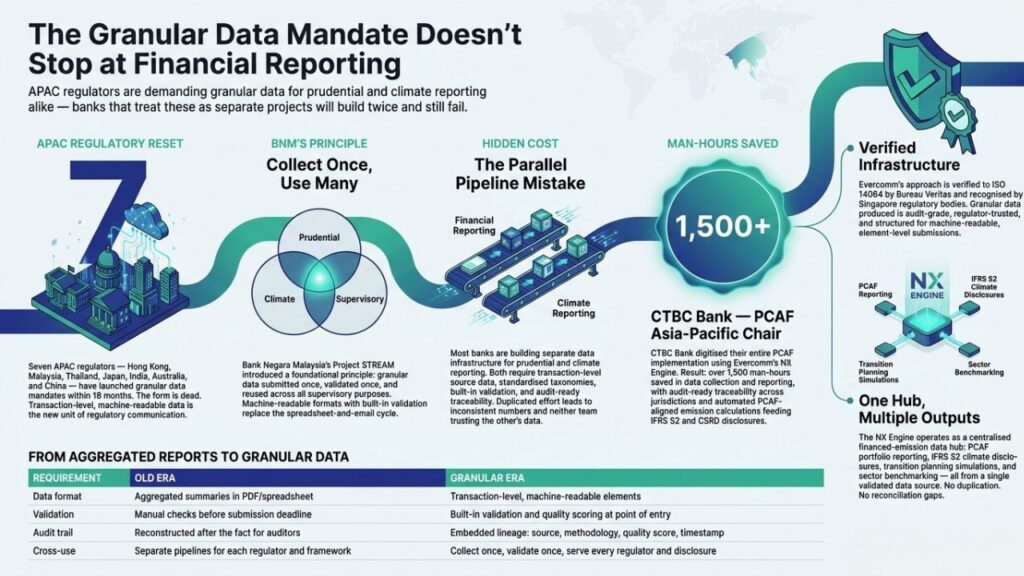
Malaysia’s Project STREAM, led by Bank Negara Malaysia, introduced a principle that deserves attention far beyond Kuala Lumpur: “Collect Once, Use Many.” Rather than asking banks to fill multiple forms with overlapping data, BNM is building a system where granular data is submitted once and reused across supervisory purposes. Machine-readable formats with built-in validation replace the old spreadsheet-and-email cycle.
 
Thailand’s RDT Phase 2 follows a similar logic. The Bank of Thailand is replacing form-based reports with entity-level and data-element-level submissions — moving from asking “what does this report say?” to “what does the underlying data show?”
 
Japan has already begun full-scale granular data collection from the Bank of Japan as of March 2025.
 
India’s RBI is shifting to element-based reporting.
 
Australia’s APRA is moving toward data-driven supervisory analysis. And China’s Yi Biao Tong, now in its initial rollout phase through December 2027, aims to unify reporting across banking, insurance, and securities under one granular data architecture.
 
The common thread is unmistakable. Every regulator listed above has concluded that aggregated, form-based reports no longer provide the supervisory visibility they need. The replacement is universally the same: raw, transaction-level, machine-validated granular data that regulators can slice, query, and analyse on their own terms. Whether the label is GDR, STREAM, RDT, or Yi Biao Tong, the architectural blueprint is converging.
 
The direction is unanimous. The question for banks is not whether granular data will be required, but whether their infrastructure can serve more than one master.
 

The mistake: treating climate data as a separate problem

 
Here is where most banks are making a costly error.
 
Financial reporting teams are investing in granular data infrastructure to meet GDR 3.0, Project STREAM, or RDT Phase 2. Meanwhile, sustainability teams — often in a different building, reporting to a different executive — are building their own infrastructure to meet IFRS S2 disclosure requirements, MAS climate risk guidelines, and PCAF financed emissions calculations.
 
The two workstreams share almost identical underlying requirements:
Transaction-level source data, not aggregated summaries
Standardised taxonomies and data dictionaries
Built-in validation and quality scoring at the point of submission
Audit-ready traceability — every number must be defensible to a regulator or verifier
Machine-readable outputs that integrate with downstream analytics
 
The overlap is not partial. It is structural. A bank’s loan-level exposure data feeds both its prudential reporting and its Scope 3 Category 15 financed emissions calculations. The asset-level energy consumption data that supports IFRS S2 climate disclosures is the same data that informs credit risk models under Basel ESG requirements.
 
Yet most banks are building parallel pipelines — separate extraction, separate transformation, separate validation, separate storage. The result: duplicated effort, inconsistent numbers, and neither team confident in the other’s data.
 
BNM’s “Collect Once, Use Many” principle was designed precisely to prevent this. But the principle applies just as forcefully to climate and emissions data as it does to prudential reporting. Granular data collected at the asset level, validated once against a common standard, and served to multiple downstream consumers — financial, supervisory, and climate — is not just more efficient. It is more accurate.

Granular Data Infographic

What a unified granular data architecture actually looks like

 
The banks getting this right share three characteristics.
 
First, they centralise at the source. Rather than allowing each reporting function to maintain its own data lake, they invest in a single granular data hub that ingests transaction-level and asset-level data from core systems. This hub becomes the authoritative source for both prudential and sustainability reporting.
 
Second, they standardise early. Granular data is only useful if it conforms to a consistent taxonomy. Leading banks align their data dictionaries not just with their primary regulator’s schema, but with international disclosure standards — IFRS S2, PCAF methodology, and ISO frameworks — from the outset. This avoids the painful reconciliation work that comes from mapping between incompatible schemas after the fact.
 
Third, they build verification into the pipeline, not after it. Audit-ready traceability is not something you bolt on before a reporting deadline. In a well-designed granular data architecture, every calculation — whether it is a risk-weighted asset figure or a financed emissions intensity metric — carries its lineage: the source data, the methodology applied, the quality score, and the timestamp.
 
This is the infrastructure pattern that APAC regulators are converging toward. It is also, not coincidentally, the pattern required for credible climate disclosure under IFRS S2 and PCAF.
 
How Evercomm enables the unified data layer for emissions
 
Evercomm has been building granular data infrastructure since 2013 — specifically for the emissions and climate reporting side of this equation.
 
The NX Engine, Evercomm’s core platform, powers financed emissions calculations at Scope 3 Category 15 and asset level. It operates as a centralised financed-emission data hub: integrating multiple data sources into a unified, PCAF-aligned structure with AI-driven calculation, verification, and data quality scoring built in.
 
CTBC Bank — the PCAF Asia-Pacific Chair — uses the NX Engine to digitise their entire PCAF implementation. The results are concrete: over 1,500 man-hours saved in data collection and reporting cycles, audit-ready traceability across jurisdictions, and automated PCAF-aligned emission calculations that feed directly into IFRS S2 and CSRD-aligned disclosures.
 
The parallels to BNM’s “Collect Once, Use Many” model are direct. Granular data enters the system once — at the asset level, at the transaction level — and serves multiple downstream purposes: PCAF portfolio reporting, IFRS S2 climate disclosures, scenario simulation for transition planning, and sector-specific benchmarking. No duplication. No reconciliation gaps.
 
Evercomm’s approach is verified to ISO 14064 by Bureau Veritas and recognised by Singapore regulatory bodies. The granular data it produces is not just reportable — it is audit-grade, regulator-trusted, and structured for the kind of machine-readable, element-level submissions that every APAC supervisor is now demanding.
 
For banks navigating both the prudential granular data mandates and the climate disclosure requirements simultaneously, the emissions layer is often the harder problem. Financial transaction data, however messy, lives in core banking systems with established lineage and governance. Emissions data — particularly financed emissions across diverse portfolios spanning multiple sectors and geographies — requires specialist calculation engines, sector-specific benchmarks, and science-aligned methodologies that most banks do not have in-house. That is where purpose-built granular data infrastructure earns its value — not as a standalone compliance tool, but as the emissions data layer that plugs into the broader architecture banks are already building for prudential reporting.
 

The convergence is structural, not temporary

 
The APAC regulatory reset documented by Regnology and others is not a passing trend. It reflects a permanent shift in how supervisors consume and analyse data. The form is dead. The granular data element is the unit of regulatory communication going forward.
 
Climate and sustainability reporting is following the identical trajectory — from annual PDF disclosures to continuous, asset-level, machine-readable submissions. IFRS S2 requires entity-specific, decision-useful climate data. PCAF demands loan-level emissions attribution. MAS expects banks to quantify and manage climate-related financial risks with the same rigour applied to credit and market risk.
 
Banks that build separate granular data infrastructures for financial and climate reporting will pay twice for engineering, twice for governance, and twice for assurance — and still face reconciliation problems at the seams.
 
The smarter path is to recognise that the granular data mandate is one mandate with multiple applications. Build the infrastructure once. Validate the data once. Serve every regulator, every disclosure framework, and every internal decision-maker from the same verified source.
 
The regulators already see it that way. The question is whether banks will, too.
 
Evercomm is the granular data infrastructure company powering AI with facts. To explore how the NX Engine can serve as your unified emissions data layer, get in touch.


Browse More Articles

Granular Data Thumbnail
The Granular Data Mandate Doesn't Stop at Financial Reporting
APAC regulators are demanding granular data for prudential and climate reporting alike. Banks that treat...
AI-ready data
Your AI Model Is Only as Honest as Its Data: The AI-Ready Data Gap
AI-ready data demands verification, not estimation. Three regulatory shifts reveal why granular, asset-level...
Port Decarbonization Thumbnail
Port Decarbonization Gets a New Blueprint: How Smart Energy Communities Are Changing Industrial Operations
Port decarbonization is no longer a distant goal. New research shows how smart energy communities can...

Chatbot

Hey there 👋
How can I help you today?